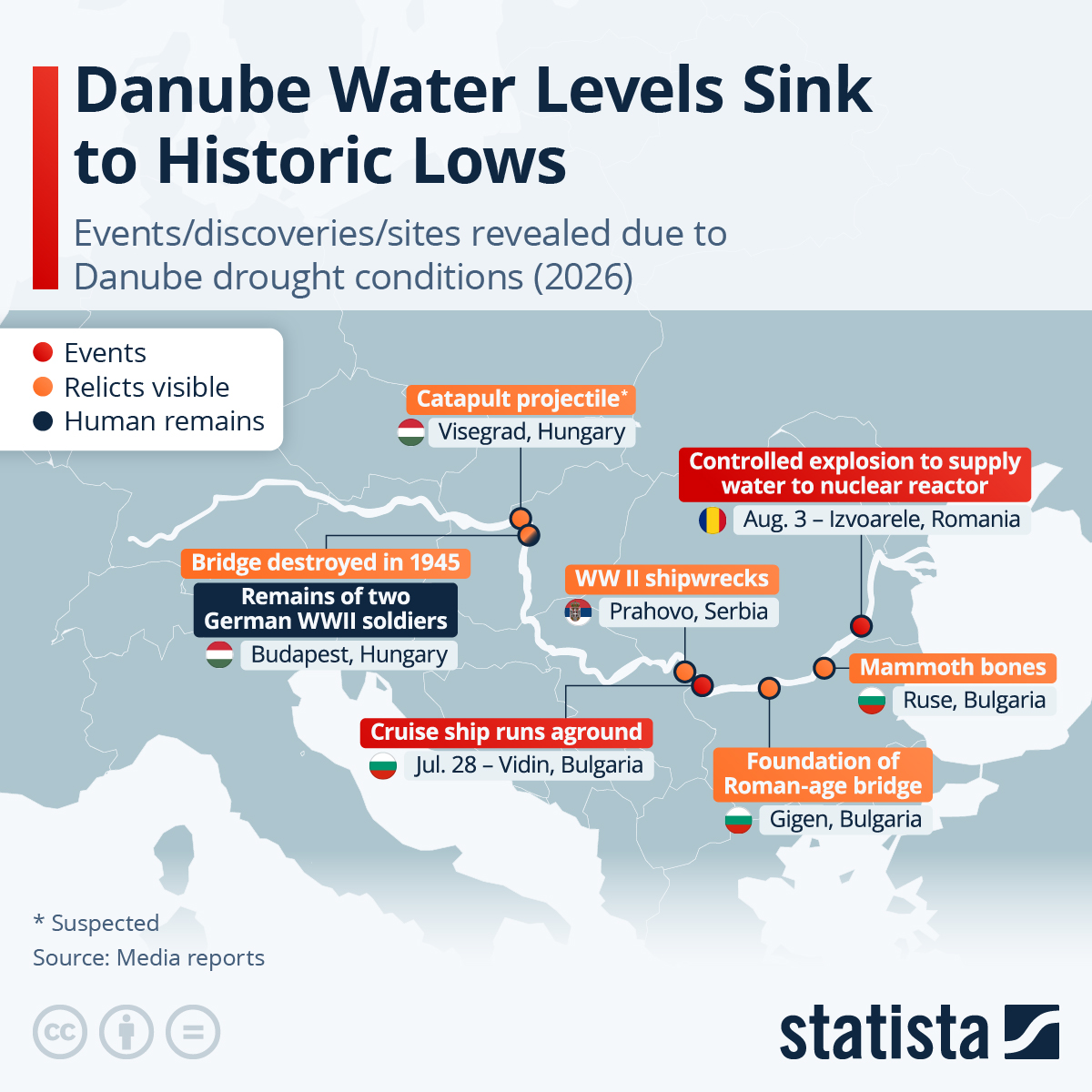
The Danube and other rivers in Europe are experiencing historic drought conditions which have thrown shipping, tourism and energy supply into disarray. Additionally, the sinking water levels that have set new all-time records in some locations have revealed historic finds from World War II to Roman times and even the Ice Age.
At the end of last month, 200 cruise passengers had to be evacuated when a Viking line river cruise ship ran aground near Vidin, Bulgaria. As of early August, cruise lines on the Danube, the Rhine and the Main are still disrupted, with itineraries being adjusted or canceled outright. Not only tourism industries are suffering from the drought, however. Critical energy infrastructure, agriculture and food supply routes are also in distress as the Danube provides irrigation to farmers and cooling to power plants. On August 3, Romanian authorities carried out a controlled explosion to divert water flow towards the country's only nuclear plant after it already had to shut down one of its two reactors in late July due to water shortages, leading to the declaration of a state of emergency. Last Thursday, it also sank four rock-laden barges in a similar plight. However, the shutdown of the second reactor on Thursday remains a possibility. A Hungarian nuclear plant which was powered down due to the low water levels is meanwhile expected to resume operations.
Like in 2022 drought conditions, the Serbian village of Prahovo saw several German World War II shipwrecks emerge which had been sunk there deliberately at the end of the war. The same happened to Budapest's Franz Joseph bridge which German forces destroyed in 1945 while retreating and which has become visible underwater from its successor structure. Also in Budapest, the discovery of the remains of two German Wehrmacht soldiers as well as a Wehrmacht motorcycle made headlines. Yet another World War II relic surfaced in Virt, Slovakia, in the form of a naval mine.
Going back in time further to the Roman era, another old bridge, or in this case its foundations, emerged from the water near Gigen in Bulgaria. In the vicinity of Hungary's Szalki Island, archaeologists discovered a part of a Roman altar dedicated to the god Jupiter and two more pieces of inscribed limestone. From the medieval age, a suspected catapult projectile was discovered in Visegrad, Hungary. Finally, the oldest find goes back the Ice Age: Mammoth bones and tusks were revealed by the retreating river in Ruse, Bulgaria, and specialists have confirmed the discovery.