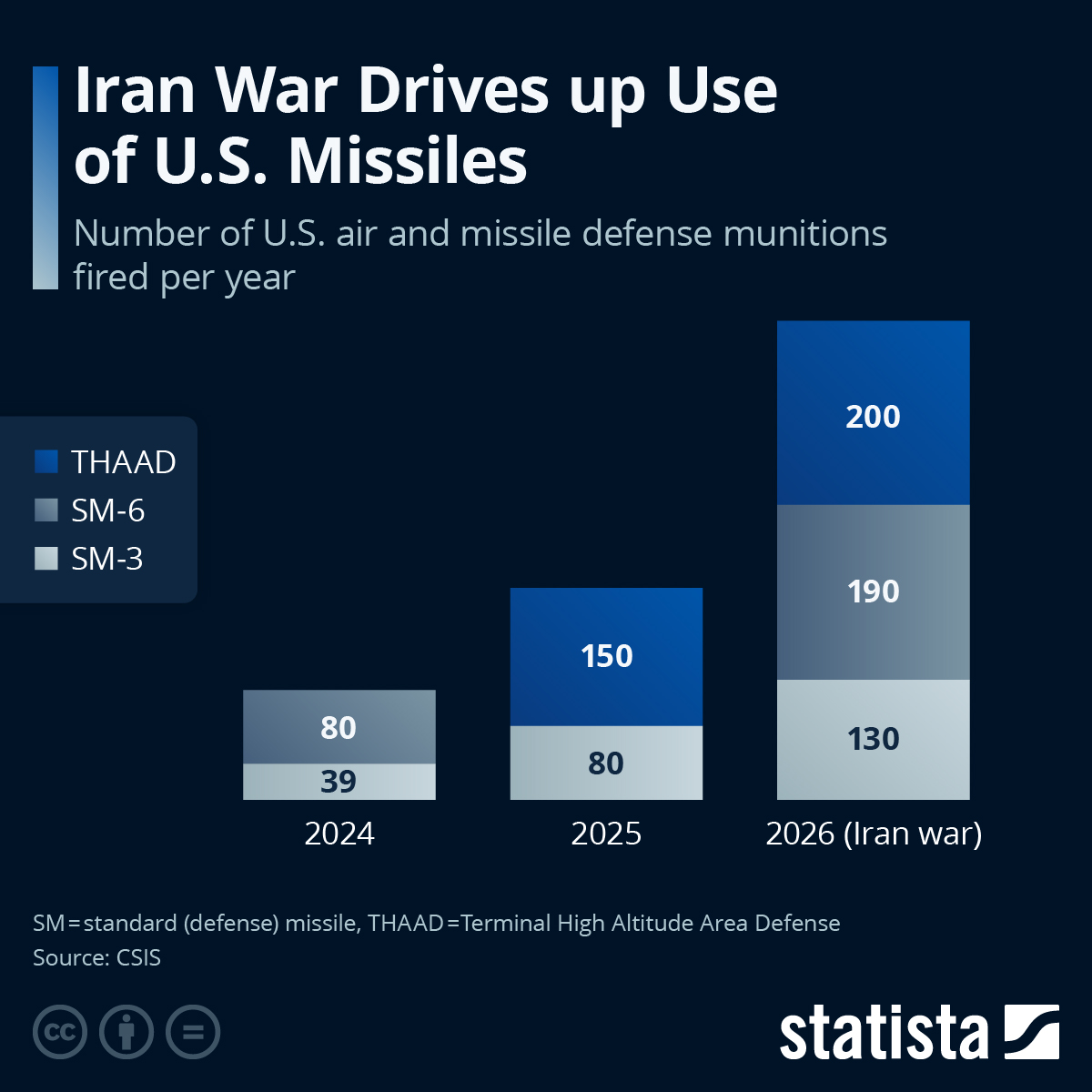
The use of U.S. interceptor missiles has risen sharply during the war with Iran, noticeably depleting stockpiles. This is according to data by think tank Center for Strategic and International Studies. According to the figures, a total of 200 THAAD interceptors were deployed between the start of the war in late February 2026 and the end of July 2026. For comparison, only 150 were used throughout the whole of 2025.
Sea-based systems also saw significantly increased use: 130 SM-3 interceptors have been used so far as part of the Iran war, whereas the total in 2025 was just 80 and only 39 in 2024. Regarding SM-6 interceptors, the U.S. has fired 190 in 2026 so far, compared to 150 the previous year. THAAD (Terminal High Altitude Area Defense) is a ground-based ballistic missile defense system, while the SM-3 and SM-6 are sea-based standard missiles designed for air and missile defense.
Even before this year that saw the start to the Iran war in February, several concurrent military operations used up numerous interceptors and other missiles, for example against Houthi militia groups in Yemen and to fend off Iranian attacks on Israel in April and October 2024.
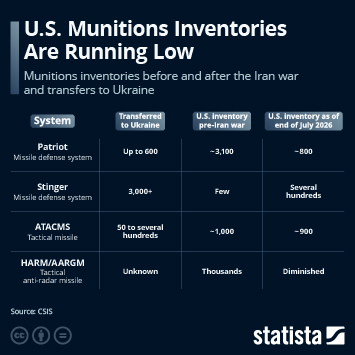
According to CSIS, the strategic dimension of this depletion is particularly critical: These specific types of munitions would be vital in a potential conflict in the Western Pacific. CSIS reports that approximately half of the initial stockpiles for systems such as Patriot and THAAD have already been expended, while around one-third of the inventory for other systems – including the SM-2/3/6, JASSM, and Tomahawk – has been used. This development could increase pressure on the defense industry and necessitate a long-term rebuilding of stockpiles.