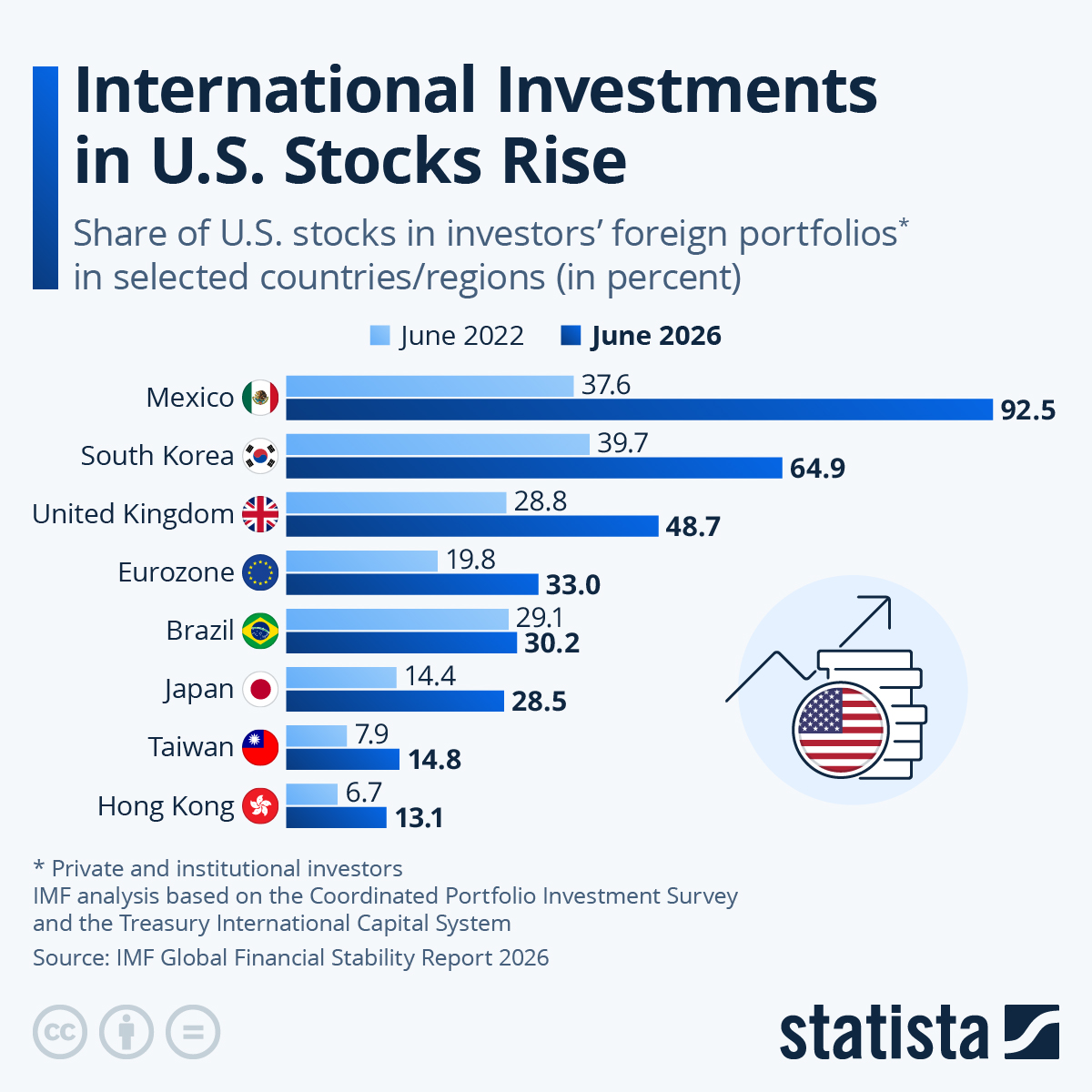
Between June 2022 and June 2026, investors around the globe concentrated their foreign portfolios on U.S. equities to an unprecedented degree. In all eight economies examined by the International Monetary Fund, the share of U.S. equities within total foreign portfolio investments increased. The trend is most pronounced in Mexico, where U.S. equities now account for 92.5 percent of all foreign investments – more than double the 37.6 percent recorded in 2022 and by far the highest figure in the survey. South Korea (64.9 percent) and the United Kingdom (48.7 percent) also show high and rising levels of investments in U.S. equities. Brazil, in contrast, has seen almost no change: Its share rose only marginally from 29.1 percent in June 2022 to 30.2 percent in June of this year.
The IMF attributes this rise to a global AI chase in which investors are tilting their portfolios toward U.S. technology firms and so-called hyperscalers – companies benefiting from the wave of investment in artificial intelligence. According to the IMF, this poses a risk to global financial stability even for economies whose own stock markets show little sensitivity to fluctuations in AI-related stocks, such as the Eurozone or the United Kingdom. This is because, in the event of a crisis and a sharp decline in the value of U.S. AI stocks, losses would transmit to these economies indirectly via the foreign investment portfolios held by their domestic investors.
The figures published in the IMF Global Financial Stability Report this October are based on an analysis that integrates two distinct data sources: holdings of U.S. equities tracked via the Department of the Treasury’s Treasury International Capital system and total foreign portfolio investments sourced from the Coordinated Portfolio Investment Survey. It is important to note that foreign portfolio investments encompass not only equities but also bonds and other debt securities. The scope of this metric is therefore broader than the term might suggest. Furthermore, the data does not distinguish between private and institutional investors as the figures represent all investor groups within an economy, ranging from central banks to pension funds, other banks, corporations and private households.