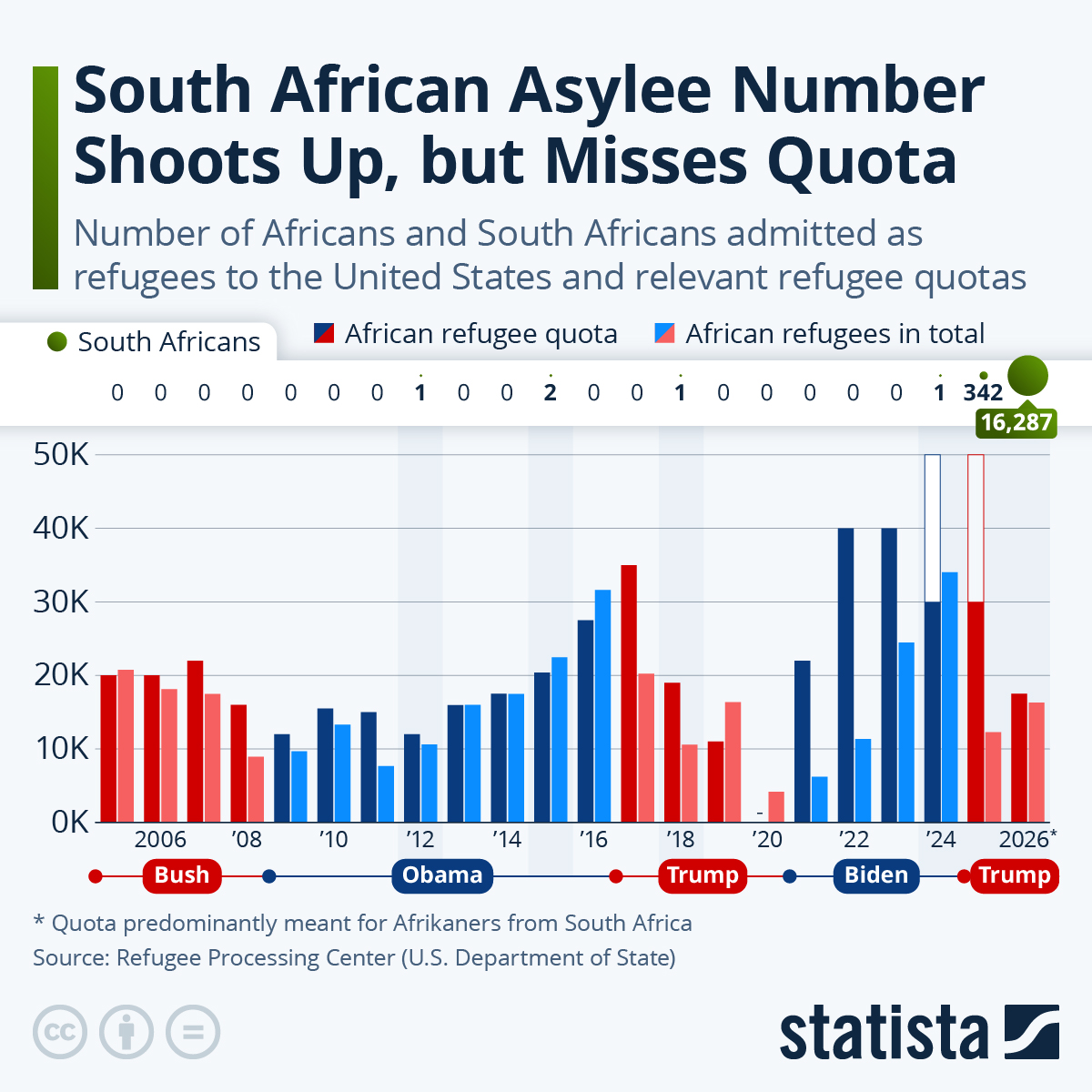
President Donald Trump in May issued an emergency change to U.S. refugee quotas due to what he described as “grave humanitarian concerns” because of “racially motivated violence” against South African Afrikaners by their government. Numbers from the U.S. Department of State for fiscal year 2026 which concluded at the end of September now show that despite the above, the United States did not fully fill its quota set aside for refugee admission in the past fiscal year.
The administration reportedly felt very dissatisfied with this result, as a leaked proposal for a $335,000 research and ad campaign that would urge more Afrikaners to apply suggests. This is despite the quota almost filled, with more than 16,000 South Africans admitted. The document and its spending proposal that was seen by The Guardian caused controversy as had the emergency declaration that implied that the situation of white, Afrikaans-speaking South Africans was currently the worst refugee situation in the world.
U.S. refugee admission figures over the past 20 years show that unfilled quotas, for Africans refugees as well as for other groups, are not overly unusual. At the same time, regional quotas do get overfilled in some years. This happened in the past under Democratic presidents who have made decisions in favor of refugees to a higher degree. African refugee numbers rose under President Barack Obama, overfilling quotas between fiscal years 2013 and 2016. They also recovered quickly from lows brought about by the coronavirus pandemic under President Joe Biden between fiscal years 2021 and 2024.
Afrikaners are descended mainly from Dutch, German and French settlers, whose language Afrikaans developed in the 17th century. Afrikaners dominated the country’s politics under apartheid, the system of racial segregation that ended in 1994. Today, they make up around 60 percent of South Africa’s white minority, which comprises 7 percent of the total population. While they historically occupied a lower socio-economic position than white English speakers, this gap has narrowed over time, with both Afrikaners and other white South Africans economically better off than Black or mixed South Africans. Around 2.7 million Afrikaners live in South Africa, meaning FY2026 U.S. refugee admissions covered 0.6 percent of them.