On Monday, Anthropic filed the paperwork for what could end up being the largest initial public offering to date. The registration filing, a whopping 335-page document, provides the public with a rare glimpse into the inner workings of a leading frontier AI model provider, laying open the immense potential of the still nascent technology as well as the near-incalculable risks associated with pushing AI further and further.
Financially, the filing reveals exponential growth, steep losses and a clear path towards profitability. Anthropic’s revenue grew from $41 million in 2023 to $16.3 billion in the first half of 2026, jumping 1,300 percent between the first six months of 2025 and 2026 alone. And while the filing shows an $80.7-billion net loss for the first half of 2026, that loss was mainly attributable to changes in fair value of convertible notes, i.e. unrelated to operations. In fact, the company posted a $974-million operating profit for Q2 2026, as revenue vastly outpaced operating expenses – most importantly compute and infrastructure expenses – over the past 18 months.
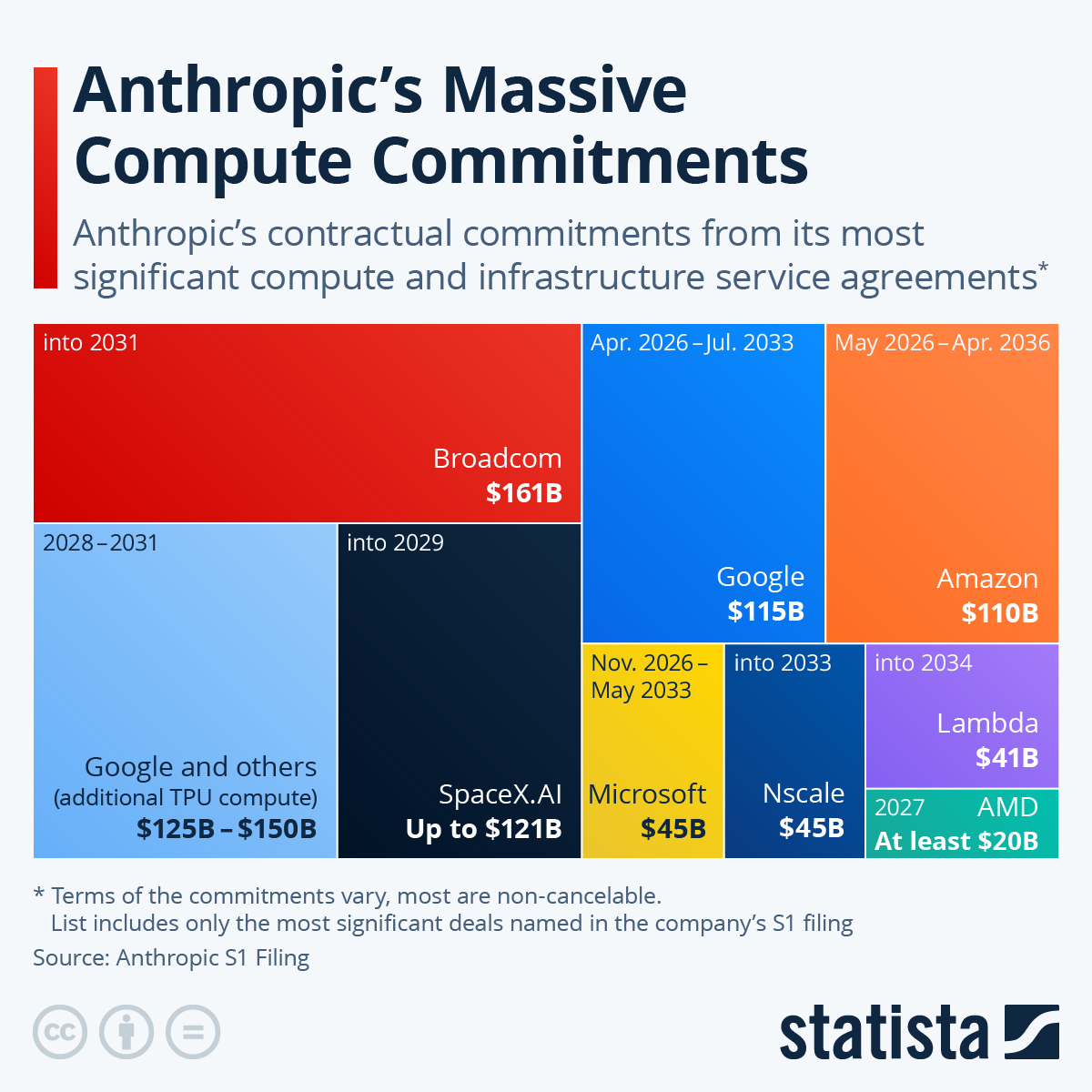
Perhaps the most significant revelation in Anthropic’s IPO filing is the fact that the company has amassed up to $800 billion in compute and infrastructure commitments. As our chart, which includes only the most significant deals, shows, Anthropic has entered $100+ billion agreements with partners including Broadcom, Google, SpaceX.AI and Amazon, most of which are non-cancelable. The scale of these commitments, coupled with the fact that a large proportion of Anthropic’s revenue is consumption-based, i.e. variable, poses a significant risk, as the company could run into trouble fast if customer and usage growth don’t continue as expected.
“We must grow our customer base and expand revenue rapidly in order to generate the cash flows necessary to satisfy these commitments,“ Anthropic wrote in its S-1 filing. “However, our revenue is primarily consumption-based, and much of it is not subject to long-term contractual commitments, while our compute and infrastructure commitments generally extend over multiple years. As a result, we may enter into these obligations based on revenue expectations that may not be realized.”