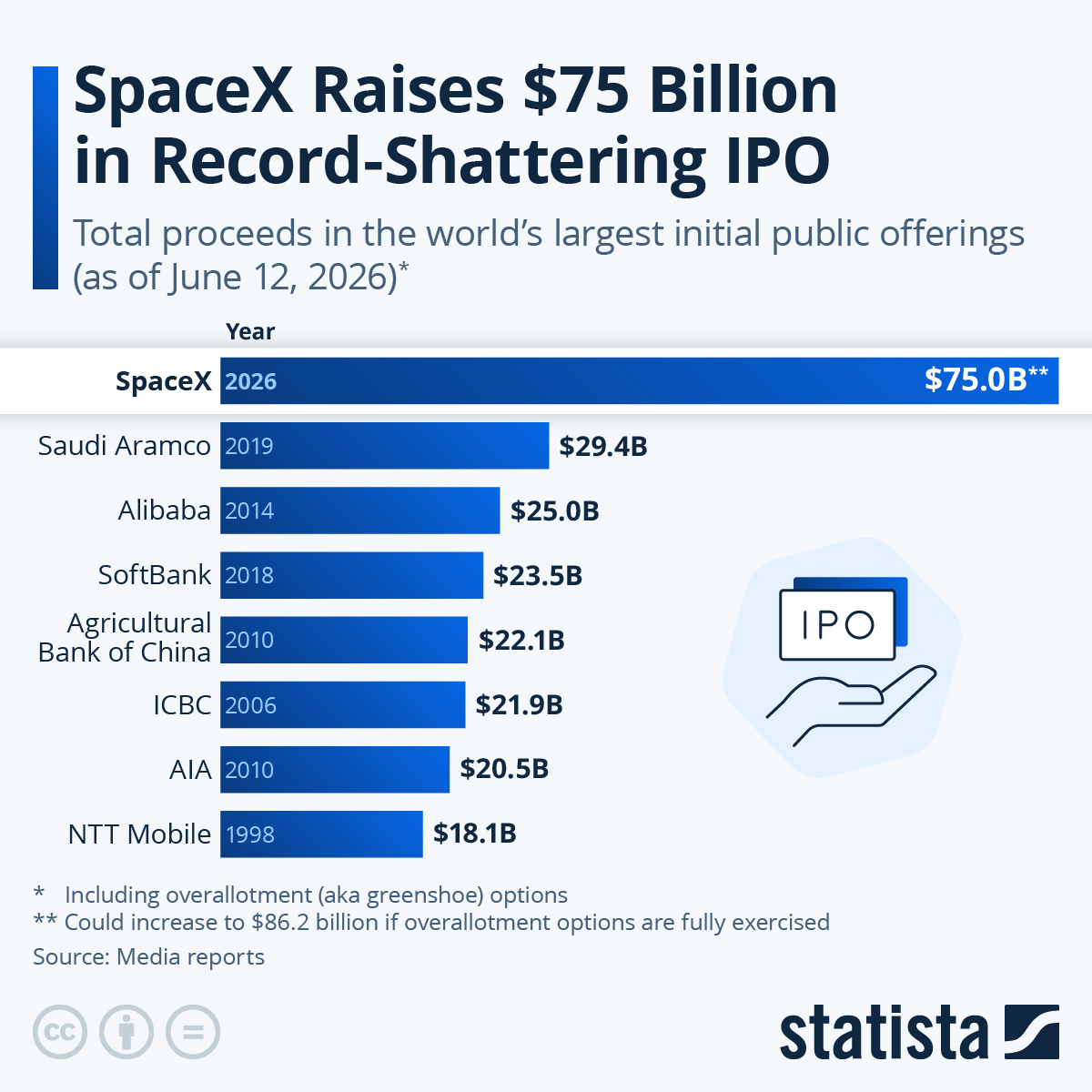
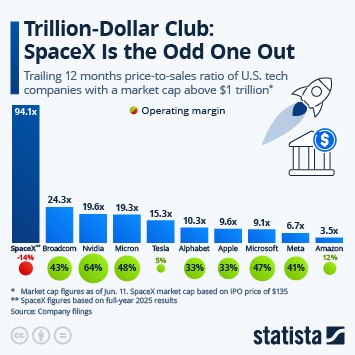
On Thursday, SpaceX confirmed the price of its initial public offering at $135 per share, making official what had already been clear since the company filed to go public last month: Elon Musk’s space exploration company, which merged with xAI – Musk’s AI firm – in February, will go public in what is by far the largest IPO of all time. At the set price, SpaceX will raise $75 billion at a valuation of $1.77 trillion, exceeding the previously largest IPO, that of Saudi Aramco in 2019, by a factor of 2.5. The total proceeds could even climb to more than $86 billion, if underwriters make use of their 30-day option to purchase an additional 83 million shares at the same price.
SpaceX will start trading on Nasdaq today and, following a rule change, it will become part of the Nasdaq-100 index in early July. This is possible because Nasdaq recently introduced a “Fast Entry” rule, under which a newly listed company with a market capitalization that puts it in the top 40 of current index constituents would be added to the index after just fifteen trading days and be exempt from seasoning and liquidity requirements.
While that may not sound like a big deal, it kind of is in this special case. Due to Elon Musk’s divisive persona and SpaceX’s lofty IPO valuation, which many say defies logic, many investors will abstain from investing in SpaceX. Once the stock is included in the Nasdaq-100, however, countless retail investors, who have index-tracking ETFs in their portfolios, will become SpaceX investors, whether they like it or not. For SpaceX, its shareholders and IPO investors, this is an added safety net, because once the stock becomes part of the Nasdaq-100, index-tracking funds will buy billions of dollars’ worth of SpaceX shares, mechanically creating huge demand for what looks like a very risky investment.
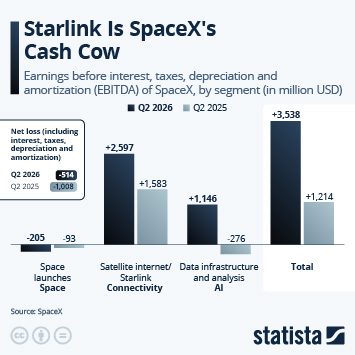
The S&P 500, meanwhile, has rules in place that will likely prevent SpaceX from joining the index anytime soon. To be eligible for S&P 500 inclusion, a company must have a public float of at least 10 percent of its total outstanding shares – a hurdle that SpaceX doesn’t clear. Even more importantly, though, the S&P 500 requires profitability. A company that wants to be included in the index must have positive GAAP earnings in the most recent quarter and in its past four quarters combined – neither of which SpaceX has achieved.