For the 17th consecutive time, the World Economic Forum has named Iceland the most gender-equal country in the world. This is according to the Global Gender Gap Report 2026, which was released earlier this week. Iceland is the only country to have closed its gender gap by more than 90 percent and one of only four economies that have consistently been in the top 10 since the index's inception in 2006. Aside from Iceland, these are Finland, Norway and Sweden, with the former two making the top three for the third consecutive year.
European economies have consistently filled most of the top 10 spots over the past two decades, with Belgium, Denmark, Germany, Ireland, Lithuania, Moldova, the Netherlands, Slovenia, Spain, Switzerland and the United Kingdom having each featured at least once in the past 20 years.
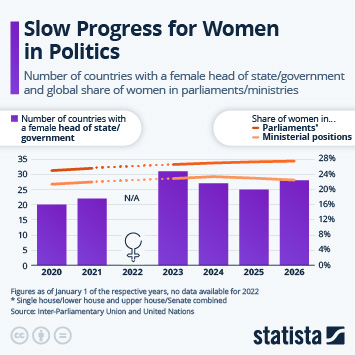
Several countries from Sub-Saharan Africa also made it into the top 10 over the years, including South Africa, ranked sixth in 2009, and Lesotho (2009, 2010 and 2011. Rwanda was in the top 10 for eight consecutive years between 2014 and 2022, partly due to the fact that it has achieved full parliamentary parity - a feat few nations worldwide have managed. Namibia first joined the top 10 in 2018, before it rose to sixth place in 2021 and climbed to a record fourth place this year.
New Zealand and the Philippines are the two countries in Eastern Asia and the Pacific to have appeared fairly consistently in the top 10 throughout the Gender Gap Report’s history, while in Latin America and the Caribbean, Nicaragua is the sole high performing country. Notably, the regions of Central Asia, Southern Asia, North America and the Middle East and Northern Africa are underrepresented at the top of the gender parity ranking.
The Gender Gap Index is a means to benchmark gender parity across four dimensions: economic opportunities, educational, health and political leadership. The level of progress toward gender parity is calculated as the ratio of the value of each indicator for women to the value for men, with a parity score of 1 indicating full parity. The index also expresses progress toward gender parity as a percentage.