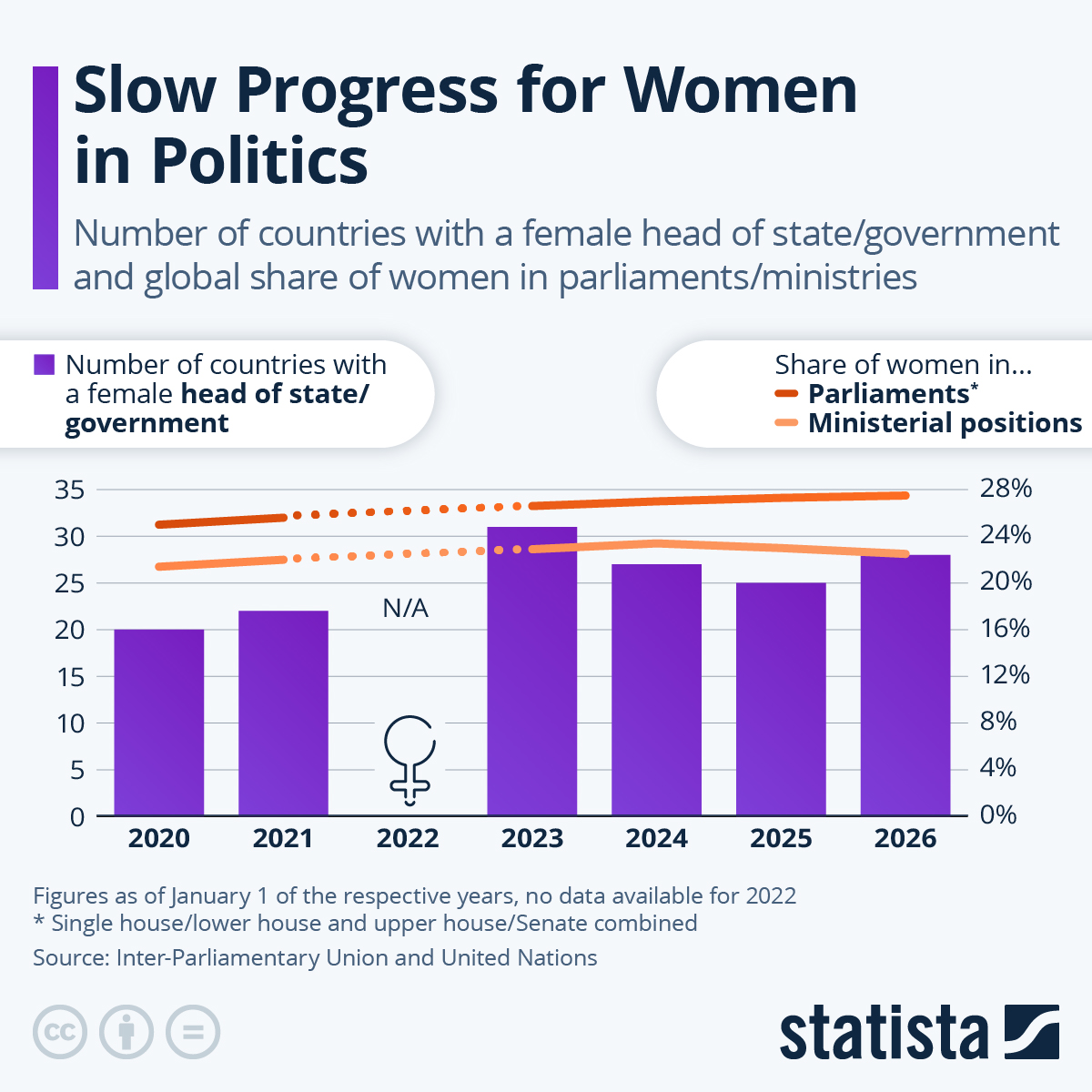
Progress in women’s political representation remains slow and uneven. According to data from the Inter-Parliamentary Union and the United Nations, the global share of women in parliaments has increased only gradually in recent years, rising from around 25 percent in 2020 to 27 percent in 2026. A similar pattern can be seen in ministerial positions, where the share edged up from 21 to 22 percent over the same period.
As our chart shows, the number of countries with a female head of state or government has fluctuated rather than followed a steady upward trend, rising from 20 in 2020 to a peak of 31 in 2023 before falling back to 25 in 2025 and increasing again to 28 in 2026. This underlines how gains at the very top of political leadership can be difficult to sustain.
Despite these modest advances, several women currently hold prominent political positions worldwide, including European Commission President Ursula von der Leyen, Mexico’s President Claudia Sheinbaum, as well as Prime Ministers Giorgia Meloni of Italy and Mette Frederiksen of Denmark. Still, with women holding just over a quarter of parliamentary seats and just over a fifth of ministerial positions, gender parity in global political leadership remains a distant goal.