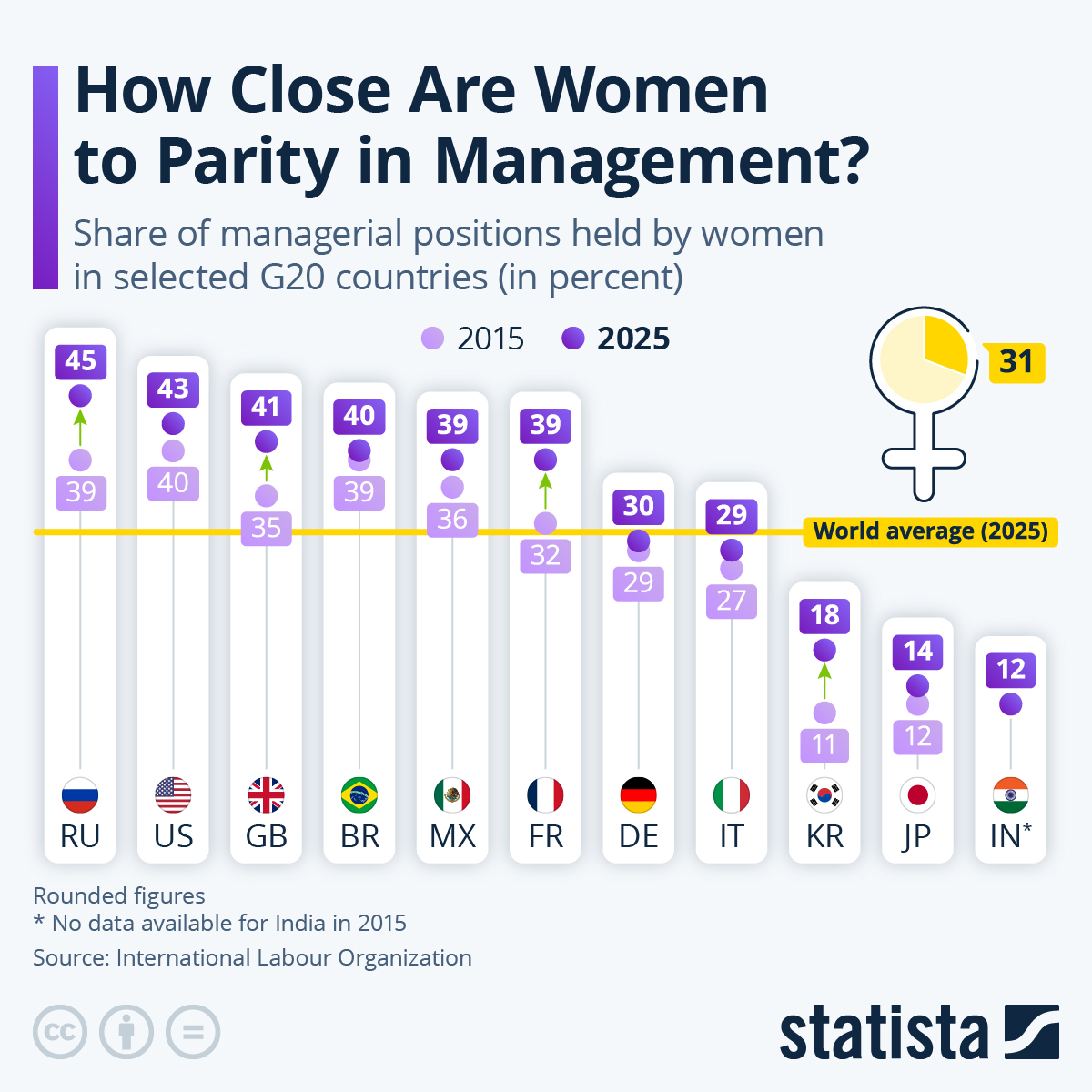
While women have made gradual progress in climbing the corporate ladder, they remain underrepresented in management positions across most of the world’s largest economies. According to data from the International Labour Organization (ILO), women held an average of 31 percent of managerial roles globally in 2025, up from 27 percent in 2015, still some distance from parity.
As our chart shows, the picture varies widely across G20 countries. Russia leads the group with 45 percent of managerial positions held by women, followed by the United States (43 percent) and the United Kingdom (41 percent). In Europe, where progress has been uneven, countries such as France (39 percent) – where policy measures such as gender quotas have supported gradual gains – Germany (30 percent) and Italy (29 percent) still show notable gaps. Elsewhere, countries such as Japan (14 percent) and India (12 percent) continue to lag far behind, highlighting persistent structural and cultural barriers to female leadership.
Over the past decade, advances have differed markedly across countries. Some have seen only marginal gains, like Germany or Brazil, while others have progressed more rapidly. South Korea stands out in this regard, increasing the share of women in management from 11 percent in 2015 to 18 percent in 2025, reflecting policy efforts to boost female labor force participation and improve workplace equality in a traditionally male-dominated corporate culture. In Russia, the notable recent increase – from 39 to 45 percent between 2015 and 2025 – may also be influenced by demographic and labor market shifts following the war in Ukraine, which has drawn a disproportionate number of men out of the civilian workforce. While such factors can temporarily raise women’s representation in management, they do not necessarily indicate lasting structural change.