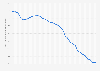
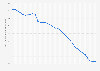
At the rate of progress achieved over the past 20 years, it would take another 120 years to reach full gender parity globally. That's according to the World Economic Forum’s Global Gender Gap Report 2026, which finds that the world is closer to gender parity than ever but that progress is fragile and slow. Twenty years after the index was introduced 2006, the global gender gap is 69.2 percent closed. Across the 97 economies that have been included from the start, gender parity has improved by just 5.2 percentage points since 2006.
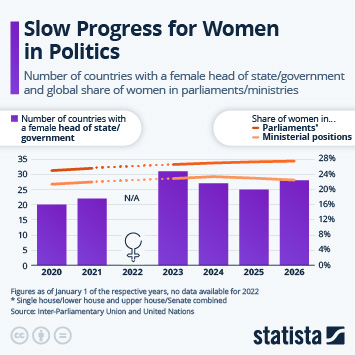
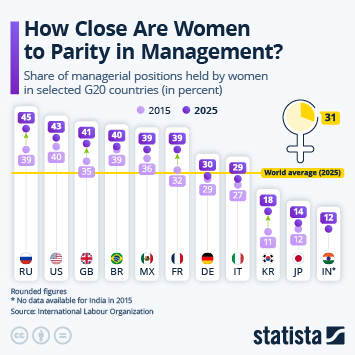
Over the years, the report’s scope has expanded, with a total of 145 economies analyzed in the 2026 edition. Each year's index ranks these countries on their respective levels of gender equality across four dimension, where 100 percent is considered full parity. The headline figure of 69.2 percent parity hides the huge variation that exists across the different subindexes and their components. While the world is close to gender parity in the subindexes for Educational Attainment and Health and Survival, parity is much further away for Economic Participation and Opportunity and, most extremely, for Political Empowerment, where part of the past progress has actually been undone in recent years.
The Political Empowerment subindex also shows the widest variation across economies, ranging from just 0.6 percent in Vanuatu to 95.4 percent in Iceland. The report states that out of the 145 economies covered, only 13 had closed the political empowerment gap more than halfway. These were: Iceland, Finland, Norway, the UK, Nicaragua, Germany, New Zealand, Namibia, Mexico, Australia, Ireland, Denmark, Bangladesh and Sweden.
"The past twenty years have shown that gender gaps can close. The task for the next twenty is to close them faster," Saadia Zahidi, Managing Director of the World Economic Forum writes in her foreword. "As a new economic era takes shape, we have an opportunity to ensure that its institutions, technologies and sources of growth draw on the talents of all people. Gender parity is not simply an outcome of progress; it is one of the foundations on which future progress will be built."