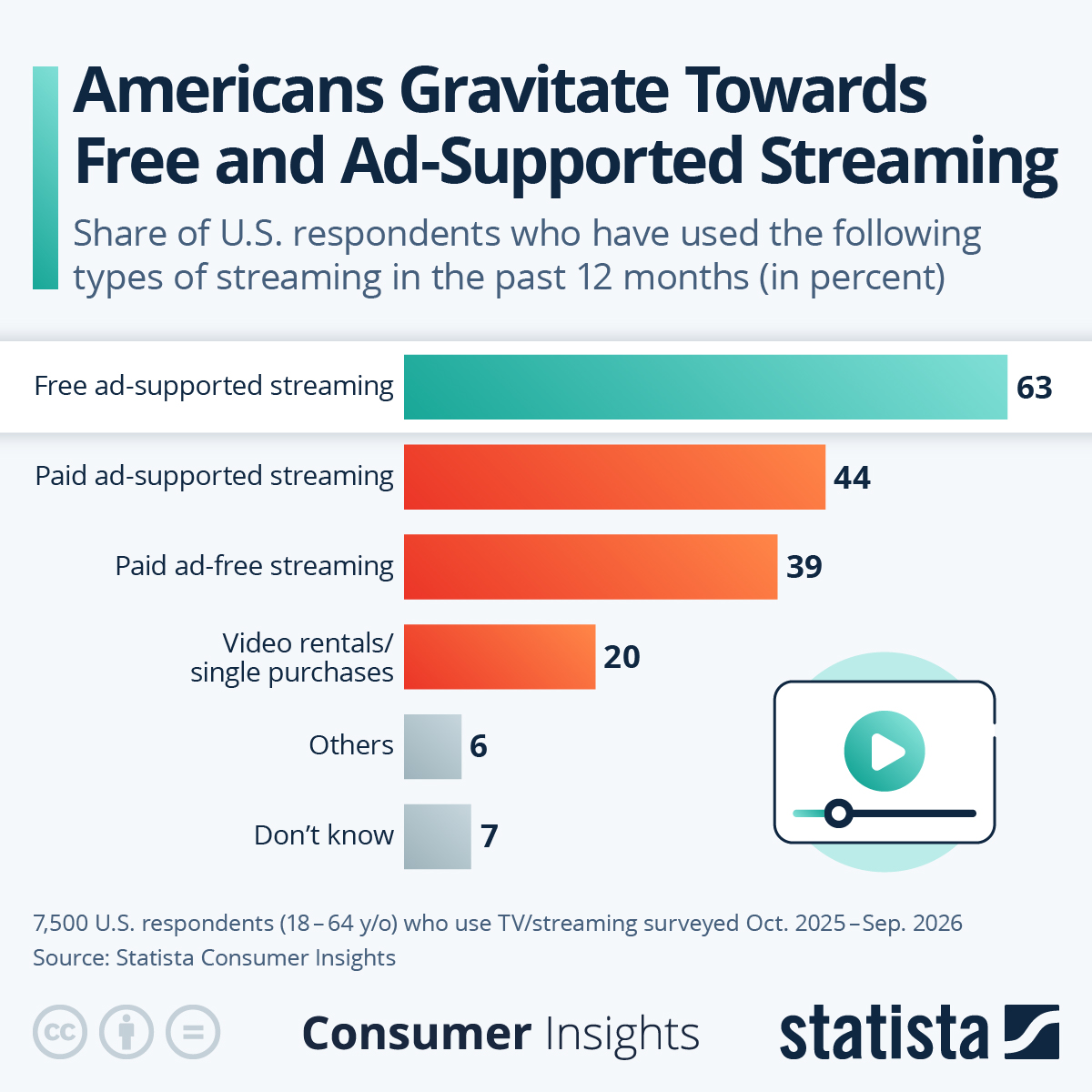
Paying less or nothing at all for video streaming in exchange for watching advertisements? A recent survey by Statista Consumer Insights reveals that many respondents prefer such a subscription model. In the United States, 63 percent of respondents said they had used free ad-supported models, like for example YouTube, in the past 12 months. This is followed by paid models that include advertising (44 percent) and traditional, ad-free paid subscriptions (39 percent).
The data shows that advertising in streaming is no longer a marginal phenomenon, but has become the norm. Many users are willing to accept commercial breaks in exchange for lower-cost or even free content. Video rentals and individual purchases are used far less frequently, at 20 percent, underscoring the long-term decline of the traditional pay-per-view model compared to subscription-based offerings.
For providers such as Netflix, Disney+, and Amazon Prime Video, the high uptake of free or low-cost, ad-supported options means that growth and customer retention are increasingly driven by hybrid models, in which advertising serves as a core revenue pillar. Against a backdrop of rising subscription prices and pressure to grow, these platforms are leaning more heavily into ad-supported tiers – both to retain price-sensitive users and to reach new target audiences.
In the case of Netflix, this strategy has already hit revenues, however, as more ad-supported accounts mean that customers have to be engaged on the platform to a certain degree to view ads. Due to Netflix recently experiencing fewer hours of content viewed per user, this can pose a problem.