As the world grapples with the urgent need to limit global warming to less than 2.0° Celsius, carbon dioxide removal technologies have moved from the margins to the mainstream of climate strategy. However, innovative solutions like carbon capture from the air and the ocean still cost a fortune compared to traditional carbon capture methods centered around reforestation and the restoration of other natural environments. Yet, new carbon capture methods could at scale still complement traditional environmental ones which can come up against space constraints, are at risk of destruction by wildfires and illegal logging activity and are also viewed as less reliable in terms of carbon credit accounting.
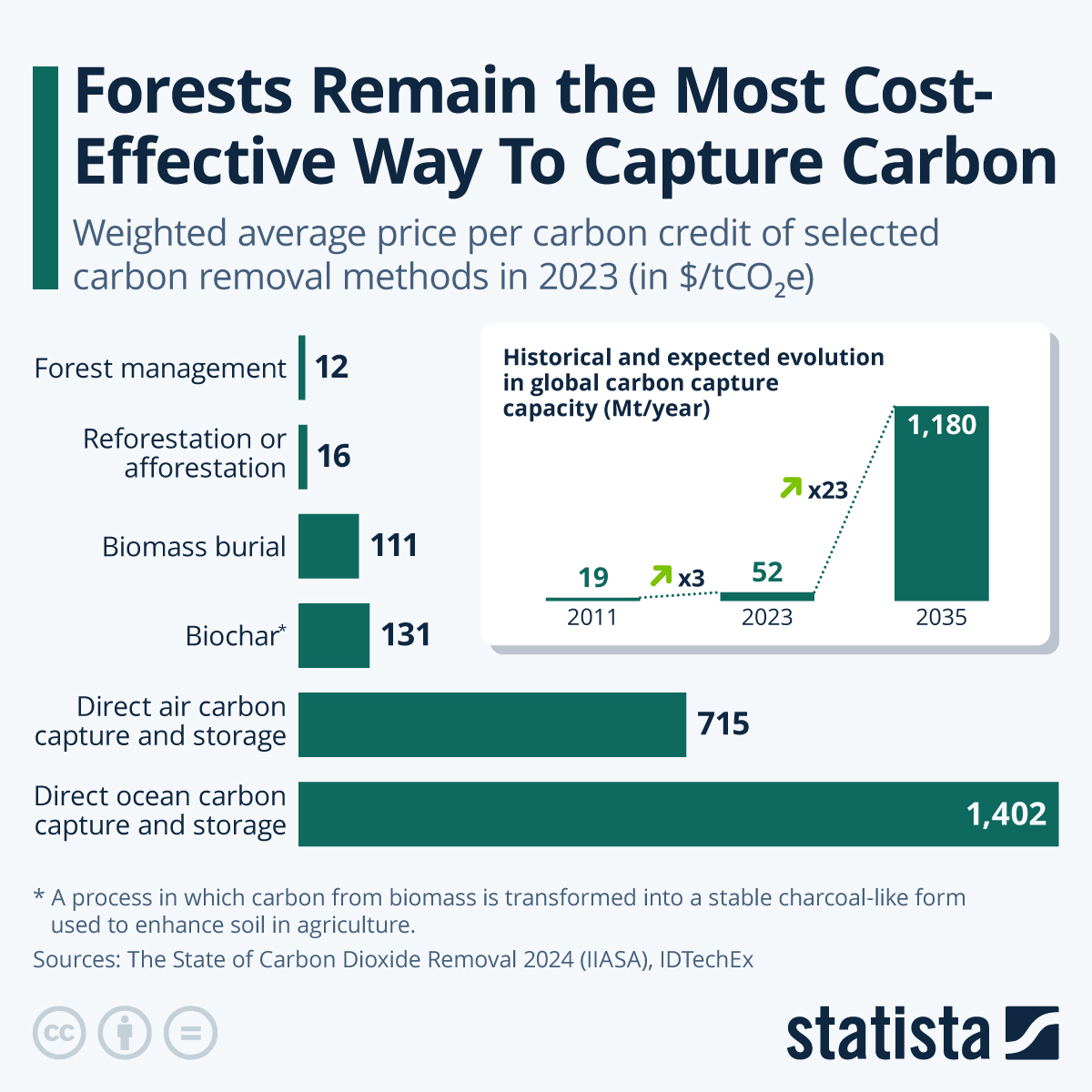
Carbon dioxide removal technologies encompass a spectrum of different approaches, each with distinct costs, maturity levels and challenges. As highlighted by data published in The State of Carbon Dioxide Removal 2026 report, forest management, afforestation and reforestation remain by far the most cost-effective, with a weighted average price in 2025 of just $17 per tonne of CO₂ equivalent captured, while the price is $29 per tonne on average when using peatland and coastal wetland restoration.
In comparison, a mid-range option like biochar soil enhancement, a process in which carbon from biomass is transformed into a stable charcoal-like form, is currently about five to eight times more expensive. In 2025, the weighted average price to remove one ton of CO₂ through biochar was around $136. With technology readiness levels already high, biochar not only already represents a mature technology to sequester carbon, but also enhances soil health and fertility in agriculture. Yet, its deployment is limited by feedstock availability and the need for standardized production and application methods.
Also quite well developed is the method of bioenergy with carbon capture and storage, which means that bionenergy plants capture, liquify and store the carbon they produce underground instead of releasing it into the atmosphere. A mid-range option that is still at an earlier stage of development is biomass burial, in which biomass like dead or leftover wood is collected and buried before it can rot and release carbon or be burned. While similar in process to bioenergy carbon capture, the method has not advanced as far.
The report also mentions other more experimental methods in the middle price range, which like bio-oil storage and biomass sinking work along similar lines. It also lists alkalinity enhancement of water bodies and enhanced weathering, which are based on finely grounding silicate rocks that can capture and solidify CO₂ from rain or ocean water.
At the high-tech end, direct air and ocean carbon capture methods promise a more precise and scalable CO₂ removal, but come at a steep price. These cost $600 to $1,100 per ton on average in 2025. While the technology readiness of these solutions are still advancing, their energy intensity and high costs remain major hurdles. Most existing projects rely on renewable energy, but scaling up direct carbon capture from air and ocean will require breakthroughs in efficiency, yield and cost reduction.