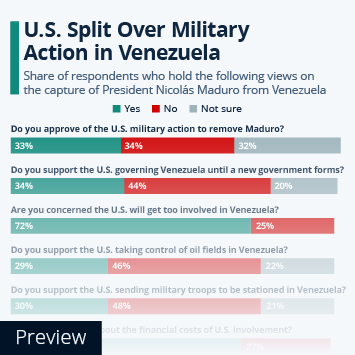
The U.S. public is split over its military action in Venezuela to remove President Nicolás Maduro. A Reuters/Ipsos poll of 1,248 adults conducted January 4-5 found roughly one third approve of the move (33 percent), as a similar share disapprove (34 percent) and 32 percent remain undecided. The survey followed shortly after Maduro's abduction from Caracas with his wife, Cilia Flores, and their transfer to the U.S. for trial on drug and weapons charges.
Respondents were also asked whether they would support the U.S. governing Venezuela until a new government forms. More Americans opposed the idea than supported it (44 percent oppose, 34 percent approve). In a rapidly evolving situation, Maduro’s vice president, Delcy Rodríguez, has already been sworn in as interim president. Commenting on the situation, U.S. President Donald Trump quoted Rodríguez as saying “we’ll do whatever you want”, adding she “really doesn’t have a choice.” He later indicated in an NBC interview that Venezuela will not be holding new elections in the next 30 days.
Concerns about U.S. over-involvement in Venezuela were widespread, with 72 percent of respondents expressing concern, including 38 percent who were very concerned. Democrats were particularly likely to be worried (90 percent), while a majority of Republicans also shared the concern (54 percent).
On U.S. control of Venezuela's oil fields, more respondents said they would oppose than support the move (46 percent oppose, 29 percent support), with 22 percent unsure. Opinion was strongly divided along party lines: 59 percent of Republicans said they would support taking control of the oil, while 74 percent of Democrats opposed it. Similarly, Republicans were more likely than Democrats to support stationing U.S. troops in Venezuela, though 22 percent of GOP voters opposed it. Financial costs of U.S. involvement, meanwhile, drew concern from nearly seven in ten respondents, compared with 27 percent who were not concerned.
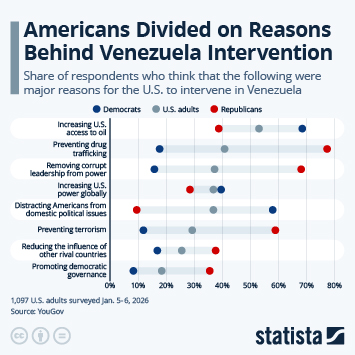
When asked about the motivations for U.S. strikes, just over half (51 percent) believed the strikes aimed to secure greater access to Venezuela’s oil. About a quarter were unsure, while another quarter disagreed. Democrats were far more likely to cite oil access as a primary reason (73 percent) than Republicans (33 percent), whereas Republicans were more likely to point to reducing drug trafficking (73 percent agreed, 8 percent disagreed), compared with Democrats (17 percent agreed, 62 percent disagreed).