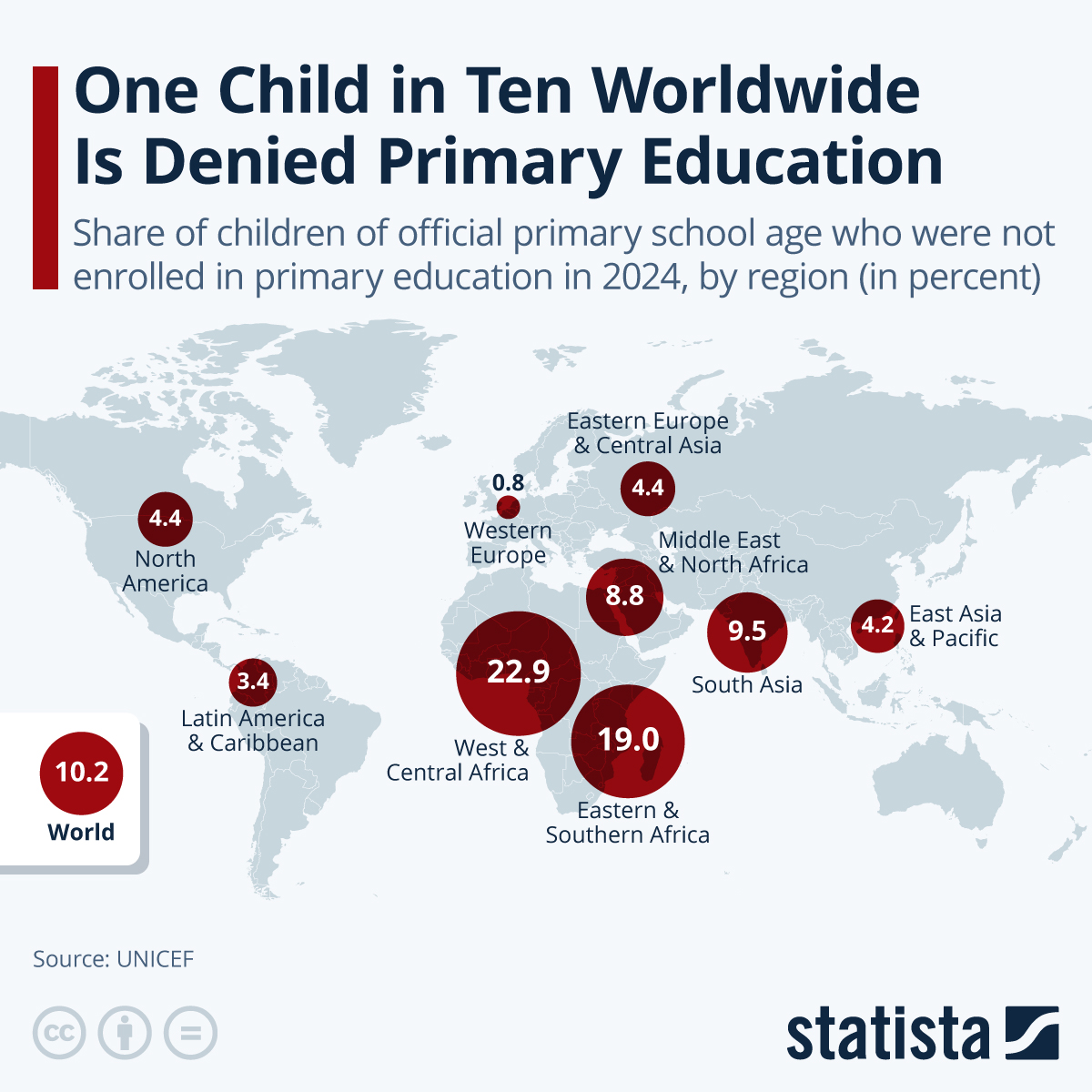
While attending elementary school is a common expectation in many high-income countries, access to basic primary education remains difficult in certain regions of the globe. As of 2024, according to data from UNICEF, West and Central Africa have the highest rate of primary-aged children out of school: at about 23 percent on average, with countries like South Sudan and Equatorial Guinea recording the worst rates globally (over 60 percent). Eastern and Southern Africa follow, with 19 percent of children not having access to primary education. Worldwide, one out of ten children is not in school at the primary level. As our infographic shows, the region with the lowest rate is Western Europe, where less than one percent of children do not attend primary school.
While progress has been made in some areas of Africa and Asia, the overall pace of reduction in out-of-school rates has stagnated over the past two decades. Gender and wealth disparities further exacerbate the issue, with girls and children from the poorest households facing the greatest barriers to education.