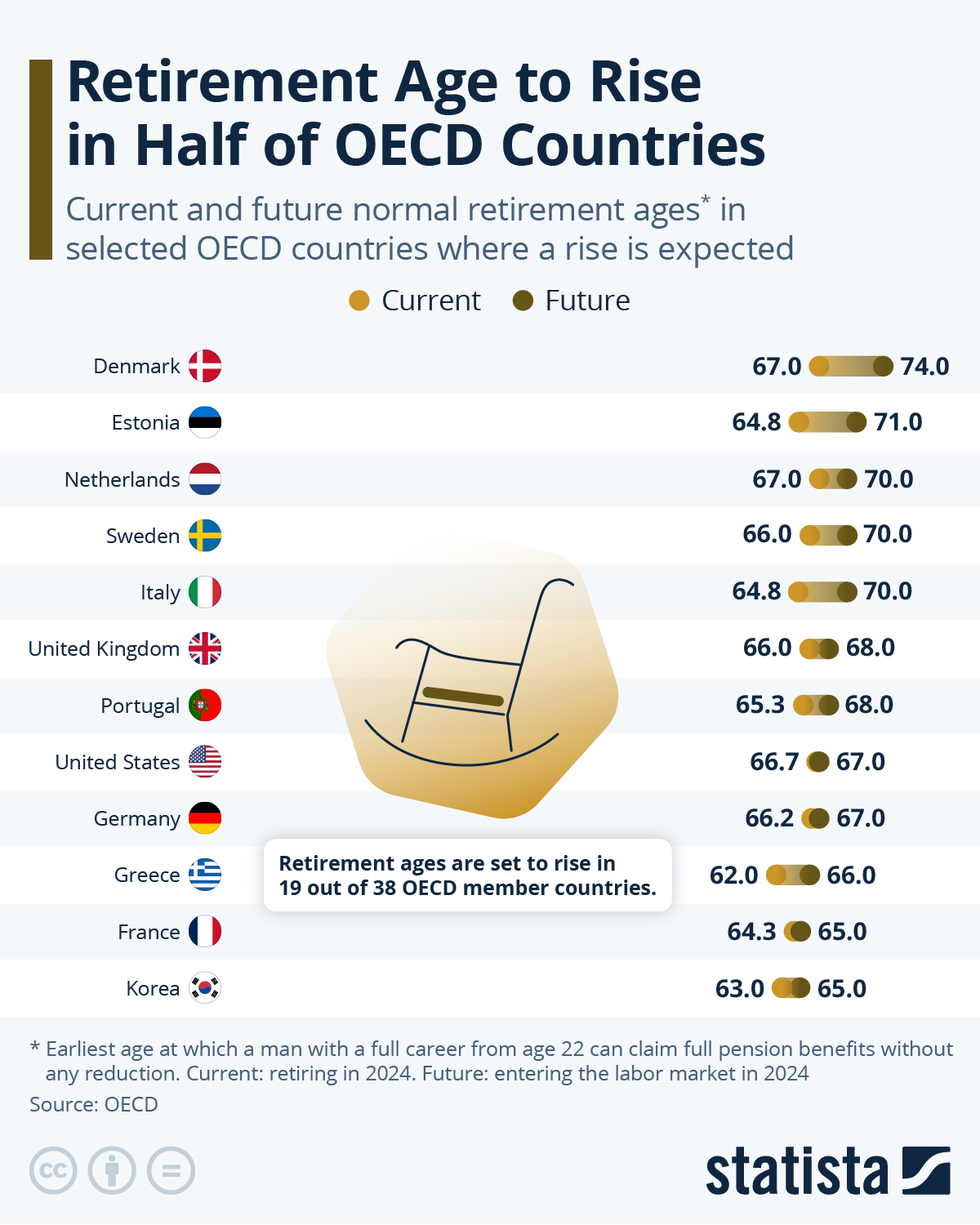
In the 2025 version of its Pensions at a Glance report, the OECD takes a look at pensions reforms undertaken by member countries over the past two years. In 2024, the average normal retirement age in OECD countries, defined as the age at which individuals permanently working full-time from age 22 are eligible for retirement benefits from all pension components without penalties, was 64.7 years for men. The normal retirement ages in OECD countries ranged from 62 years in Colombia, Greece, Luxembourg and Slovenia to 67 years in Australia, Denmark, Iceland, the Netherlands, Norway and Israel, with Turkey as an outlier with a normal retirement age of 52 years. However, the normal retirement ages are expected to increase in 19 of the 38 OECD member countries.
As our chart shows, in Denmark, which is already on the top end of retirement ages in the OECD, a man starting in a full-time career at 22 in 2024 may only be able to retire aged 74. This is due to established links between the retirement age and life expectancy, though Denmark may soften the measure after Parliament confirmed the increase in the statutory retirement age to 70 from 2040, in which case the projected future normal retirement age could be lower than 74. In Estonia, the normal retirement age is expected to reach 71, and 70 in the Netherlands, Sweden and Italy for a man in the same situation. Overall, based on already legislated measures, the average normal retirement age for men in the OECD is projected to increase by almost two years to 66.4 years for men entering the labour market in 2024.