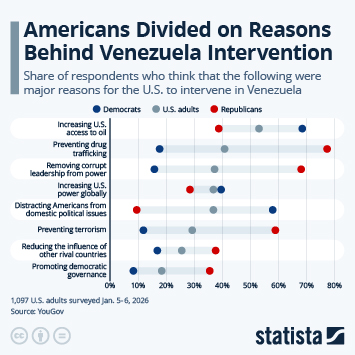
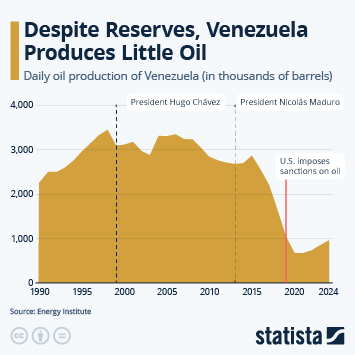
Following months of escalation, the U.S. launched an attack on Venezuela on Saturday. U.S. troops extrajudicially captured and extracted President Nicolás Maduro, in a lightning operation that killed upwards of 80 people. While the U.S. had originally maintained that its growing presence in the Caribbean was in response to drug trafficking in the region, President Trump has since stated explicitly that he intends to gain control of Venezuela's large oil reserves.
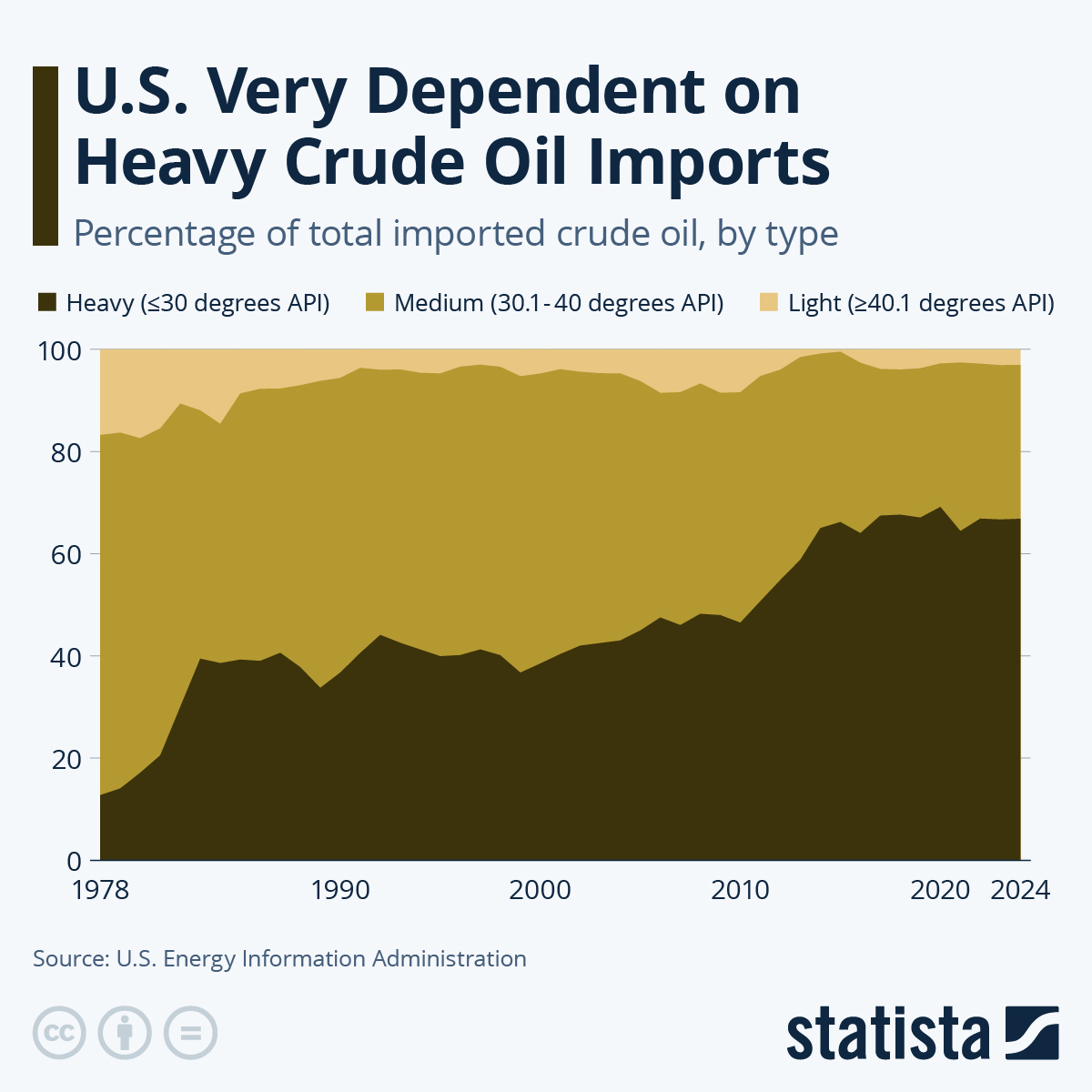
While Venezuela sits on the world's largest proven oil reserves, the country produces far less oil than the U.S. However, it's the type of oil found in Venezuela that explains America's interest. Most of America's refineries are set up to process heavy crude oil (under 30 degrees API), exactly the type of crude oil found in Venezuela, while the vast majority of the oil produced in the U.S. is light crude (over 40 degrees API). In other words, U.S. refineries can't process most of the oil produced in the country, and overhauling these refineries would cost billions of dollars. As our infographic shows, U.S. dependency on heavy crude has grown significantly in the last four decades: it represented close to 67 percent of the crude oil imported in the country in 2024, compared to 13 percent in 1978, according to data from the U.S. Energy Information Administration.