In many regions of the world, workplace safety has drastically increased over the last couple of decades, ensuring healthy working environments for many employees. However, there is still a lot of room for improvement. According to the most recent estimates from the International Labor Organization, every year, around 3 million people die of work-related accidents and diseases, most of them caused by occupational diseases (89 percent) and about 11 percent due to work accidents. In addition, an estimated 400 million additional people are victims of non-fatal work accidents each year.
According to the latest available data from the ILO (as of February 19, 2026), Costa Rica currently records the highest number of work-related injuries, with over 9,000 non-fatal and 9.7 fatal occupational injuries per 100,000 workers. Colombia and Turkey, with between 4,400-4,800 non-fatal and between 6.5-11.5 fatal accidents per 100,000 workers, are also among the worst-ranked countries on these indicators, suggesting challenges in workplace safety standards or enforcement. At the opposite end of the scale, Norway and Japan demonstrate significantly lower injury rates (between 230-520 non-fatal and 1.3 fatal per 100,000 workers), often attributed to more robust safety regulations, advanced industrial practices and strong enforcement mechanisms.
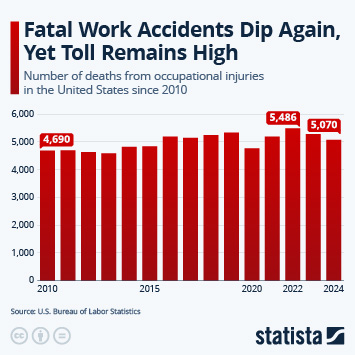
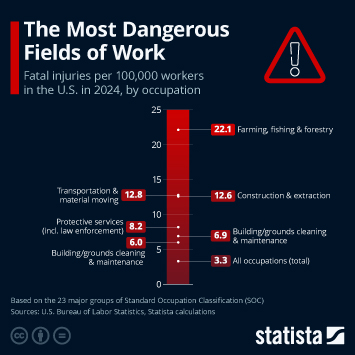
Despite ongoing efforts, the United States remains among the worst-ranked countries of the Western world, alongside France and Portugal, with 2,400 incidents per 100,000 workers and a fatal injury rate of 3.5 per 100,000. According to the most recent data released by the U.S. Bureau of Labor Statistics, the country is still facing over 5,000 work-related deaths annually. Slips, trips, falls and transportation incidents remain the leading causes of workplace fatal injuries in the U.S., especially in high-risk sectors like agriculture, farming, forestry, transportation and construction.