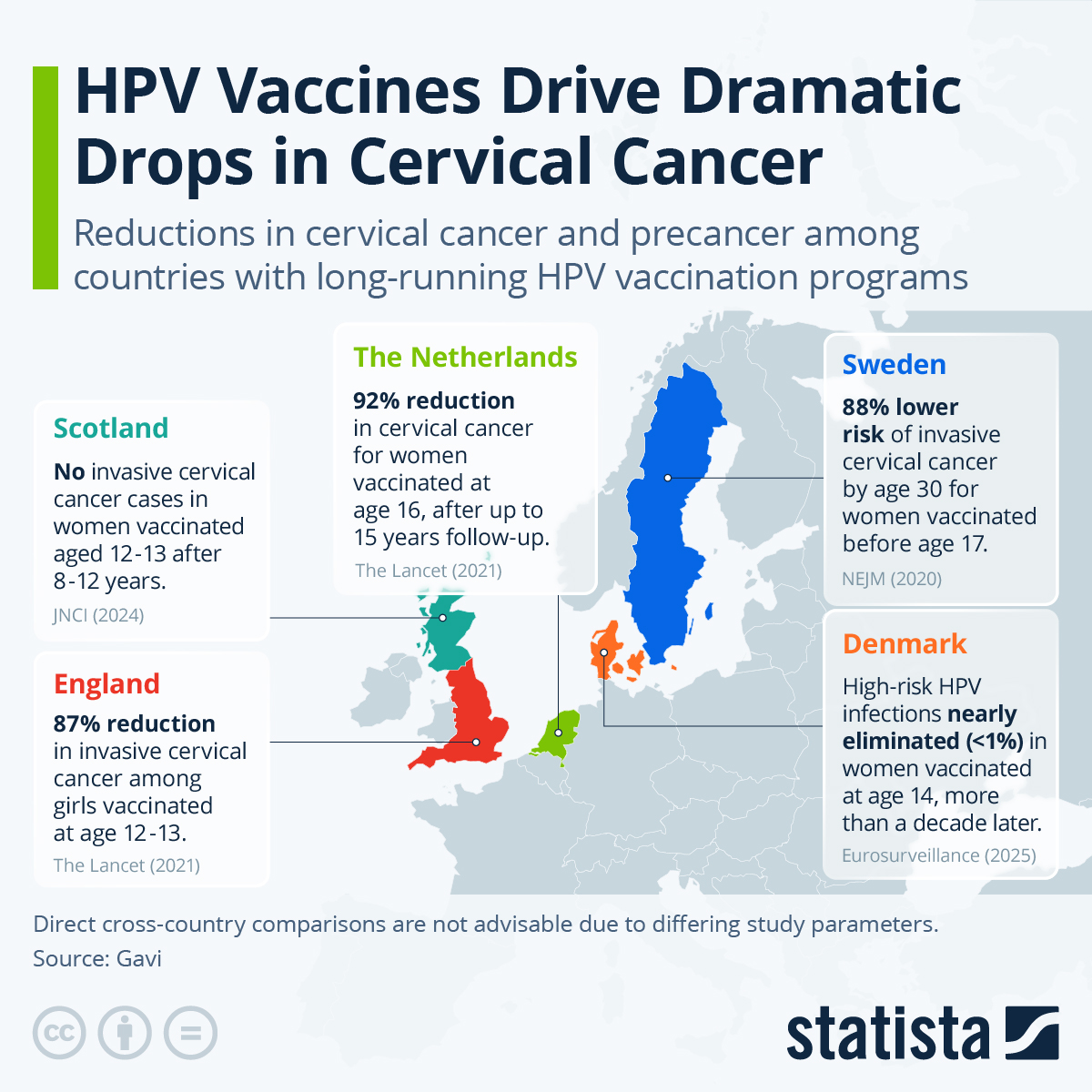
The number of new cervical cancer and precancer cases has dropped drastically in multiple countries where HPV vaccination programmes have been successfully rolled out. The following chart looks at data published by Gavi, a global organization focused on increasing access to immunization in poor countries. It shows how there have been major reductions in cervical cancer and precancer cases in Scotland, the Netherlands, England, Sweden and Denmark. Since each country records data based on its own set of indicators and timelines, cross-country comparisons are not advisable. However, as an overarching narrative: it is clear that cervical cancer cases are declining due to the success of the vaccine and its takeup.
In Scotland, researchers have found that of all the women born between January 1988 and June 1966, no cases of invasive cervical cancer were detected among those who had been vaccinated with the Cerarvix HPV vaccine at ages 12 to 13 after eight to 12 years of follow-up.
In the Netherlands, it’s a similar story. Out of 103,059 Dutch women included in the study, those who had been fully vaccinated with Cerarvix when they were 16 years old had a 92 percent lower risk of cervical cancer, as well as an 81 percent lower risk of severe precancer up to 15 years of follow-up.
The HPV vaccine Gardasil also showed to be extremely effective. In Denmark, high-risk HPV infections were nearly eliminated (<1 percent) in women vaccinated at age 14 more than a decade later. This vaccine has had a successful rollout in the United States.
Meanwhile a study by the Lancet found that in England, there was a 87 percent reduction in invasive cervical cancer cases among girls vaccinated at age 12 and 13. This was a similar figure to in Sweden, where women saw an 88 percent lower risk of invasive cervical cancer by age 30 for women vaccinated before age 17.