Tourists heading to the United States could soon have to disclose the past five years of their social media activities to authorities during the ESTA process. Where providing such information was previously only mandatory for longer-term visas, U.S. Customs and Border Protection have now submitted a new regulatory proposal to make it an essential part of short-term tourists and business travelers’ applications too. The move would be a part of a wider package of data collection measures which authorities say are necessary for security reasons. The decision is not yet legally binding, but could start to come into force from February.
The new regulation would move the inspection process to a pre-travel stage. Currently, the CBP can demand a media search of entrants’ electronic devices at random at the border, without needing a warrant or any specific reason. More “advanced” searches, which happens when a CBP or ICE official connects the device to external equipment in order to review, copy, and/or analyze its contents, requires reasonable suspicion of criminal activity or a "national security concern". CBP officers are also able to "detain” an electronic device or copies of information contained within it, usually up to a maximum of five days.
Data from the CBP shows that non-U.S. citizens are over three times more likely to have their devices checked at the U.S. border than those who hold a U.S. passport. Of the 55,318 media searches of electronics devices checks in the fiscal year of 2025, running from October 1, 2024 to September 30, 2025, 41,728 were of non-U.S. citizens, while 13,590 were of U.S. citizens.
On average, searches have historically been relatively rare. Of the total 419 million passengers processed at U.S. ports of entry last year, around 0.01 percent had their electronic devices searched. Ports of entry include international airports, road and rail crossings on land borders and major seaports, and are places where travelers can legally enter the country.
However, the number of searches, which includes the checking of mobile phones, computers, cameras, or other electronics, has been on the rise over the past decade. An increase in annual passenger footfall likely plays a part, with the dip in the number of device checks in 2020 and 2021 mirroring a decrease in travelers those years due to pandemic-related restrictions.
But this reason alone does not explain why the number of searches in 2025 nearly tripled since 2016, and increased more than six fold since 2015. In the latter year, around 382 million travelers were processed at U.S. ports of entry and the devices of 8,503 travelers were checked, working out to an average of around 0.002 percent.
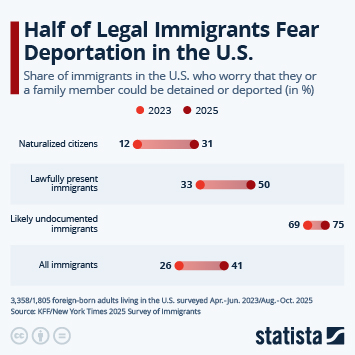
It remains to be seen how the number of checks will change over the next few years with the Trump 2.0 administration. While checks generally increased under Biden too, the new proposed regulations and string of cases of U.S. tourists and work visa holders having been detained on arrival to the U.S. this year have raised concerns that there has been a shift, with the country now carrying out greater scrutiny than before.