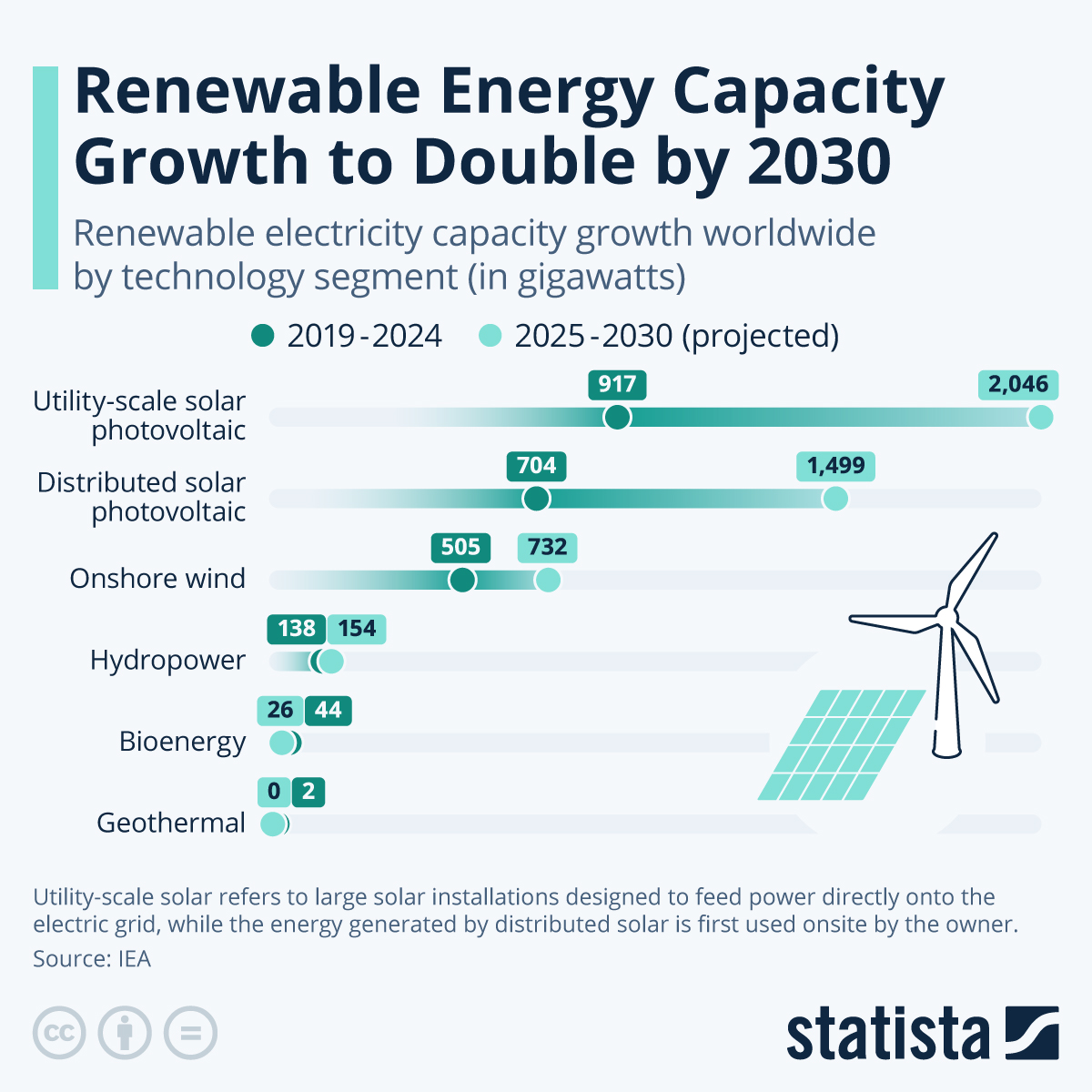
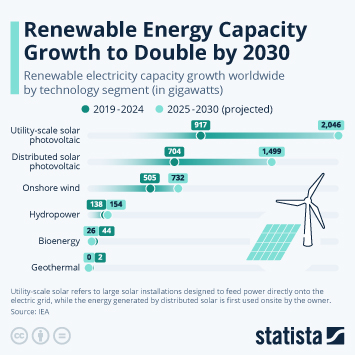
Renewable power capacity is projected to increase by close to 4,600 GW between 2025 and 2030. That's what transpires from a new report from the International Energy Agency (IEA) published today. The projected growth is equal to the combined installed power capacity of China, the European Union and Japan, or double the growth recorded between 2019 and 2024.
Growth in both utility-scale solar photovoltaic energy (produced by large solar installations designed to feed power directly onto the electric grid) and distributed solar photovoltaic energy (where the energy generated is first used onsite by the owner, and only the excess energy is sent to the grid) is expected to double, and these two segments should represent close to 80 percent of the global renewable energy capacity expansion by 2030. Compared to 2019-2024, onshore wind capacity additions should also expand by around 45 percent, with important progress being made in Africa, the Middle East, ASEAN countries, Latin America, Europe and Asia.
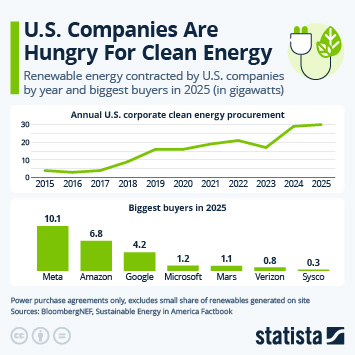
Despite this projected growth, the IEA notes that it has lowered its forecast for 2025-2030 by 5 percent compared to 2024, which represents a capacity of 248 GW. Leading this decrease is the US: the country's forecast was revised down by 45 percent across all technologies, reflecting a phase-out of investment and production tax credits for renewable energies. However, some regions should see their renewable energy capacity grow more than expected in 2024 across the 2025-2030 period, including the EU (+3 percent), ASEAN countries (+15 percent) and the Middle East and North Africa (+23 percent).