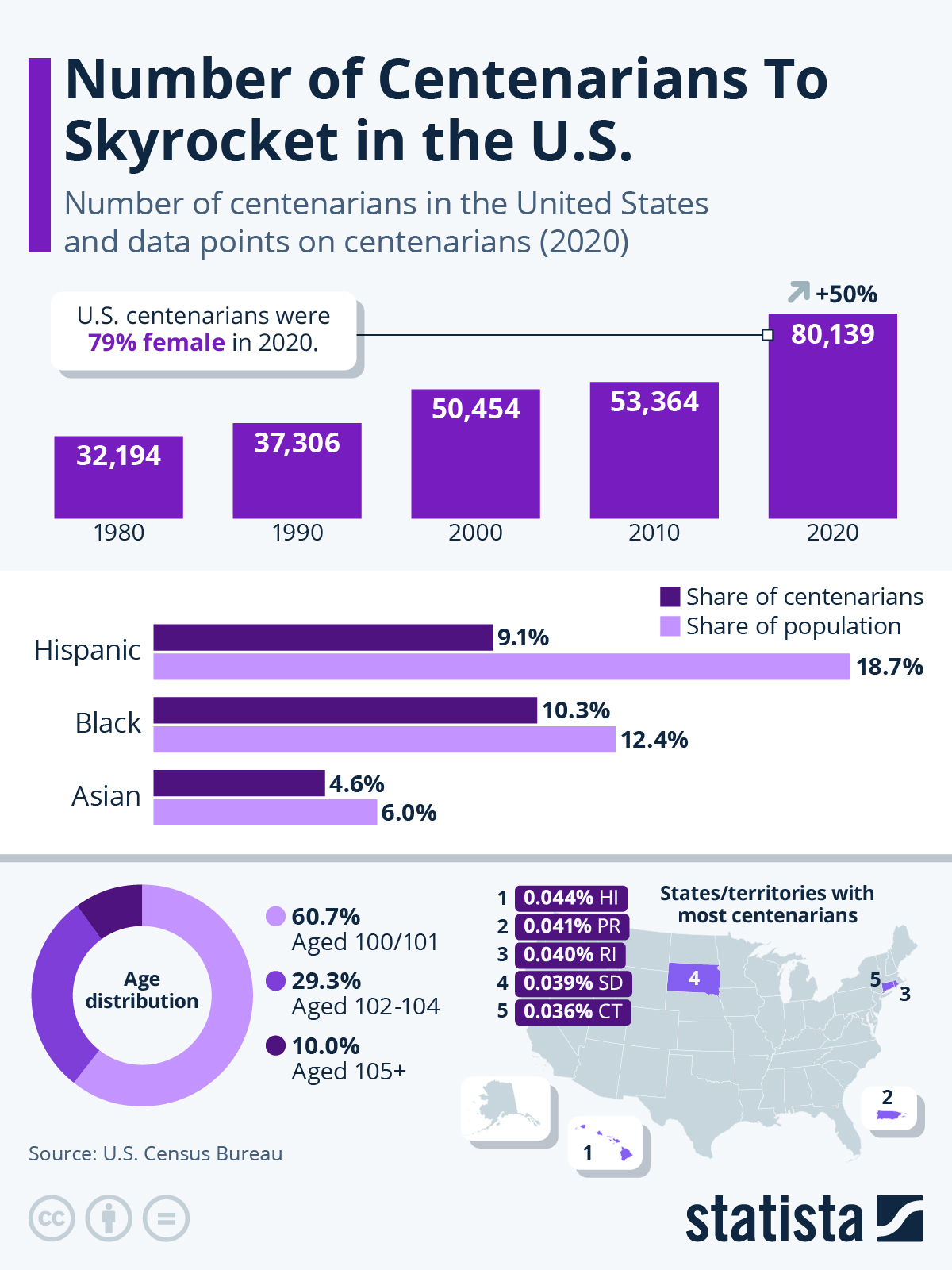
Between the 2010 and the 2020 Census, the number of centenarians in the United States grew by 50 percent to more than 80,000 as the realities of aging populations are catching up to a country that had previously outdone its peer when it came to fertility and demographic development.
The recently published Census Bureau report on centenarians shows that while they remain a very small part of the U.S. population at only two out of every 10,000 Americans, they are nevertheless emblematic of global changes that see increased life expectancy meet lower fertility rates. The country with the world’s most centenarians – Japan – has more than twice as many and has been plagued by the realities of demographic change for years.
In 2020, more than 60 percent of U.S. centenarians were aged 100 or 101, while only 10 percent were aged 105 or above. Women, who have higher life expectancies, were hugely overrepresented among the group, with 79 percent of U.S. centenarians being female. White Americans are also overrepresented in centenarian populations. Black and Asian Americans made up somewhat smaller shares of them than their overall population shares would suggest.
Meanwhile Latinos were hugely underrepresented among centenarians, with only around 9 percent of those reaching the age of 100 currently part of the group despite 18.7 percent in the country now identifying as Hispanic. This could be due to the fact that Latino populations are among the fastest growing in the U.S. and therefor have many younger members. Puerto Rico was the place with the second-most centenarians in the country, only surpassed by Hawaii.
The changing realities of aging and fertility have caused demographic change to accelerate recently in the United States. Between the 2010 and the 2020 Census, the number of Americans aged 65 and over rose by 4 percentage points to 16.8% as Baby Boomers entered retirement. Between 1990 and 2000 as well as between 2000 and 2010, this number had held more or less steady.