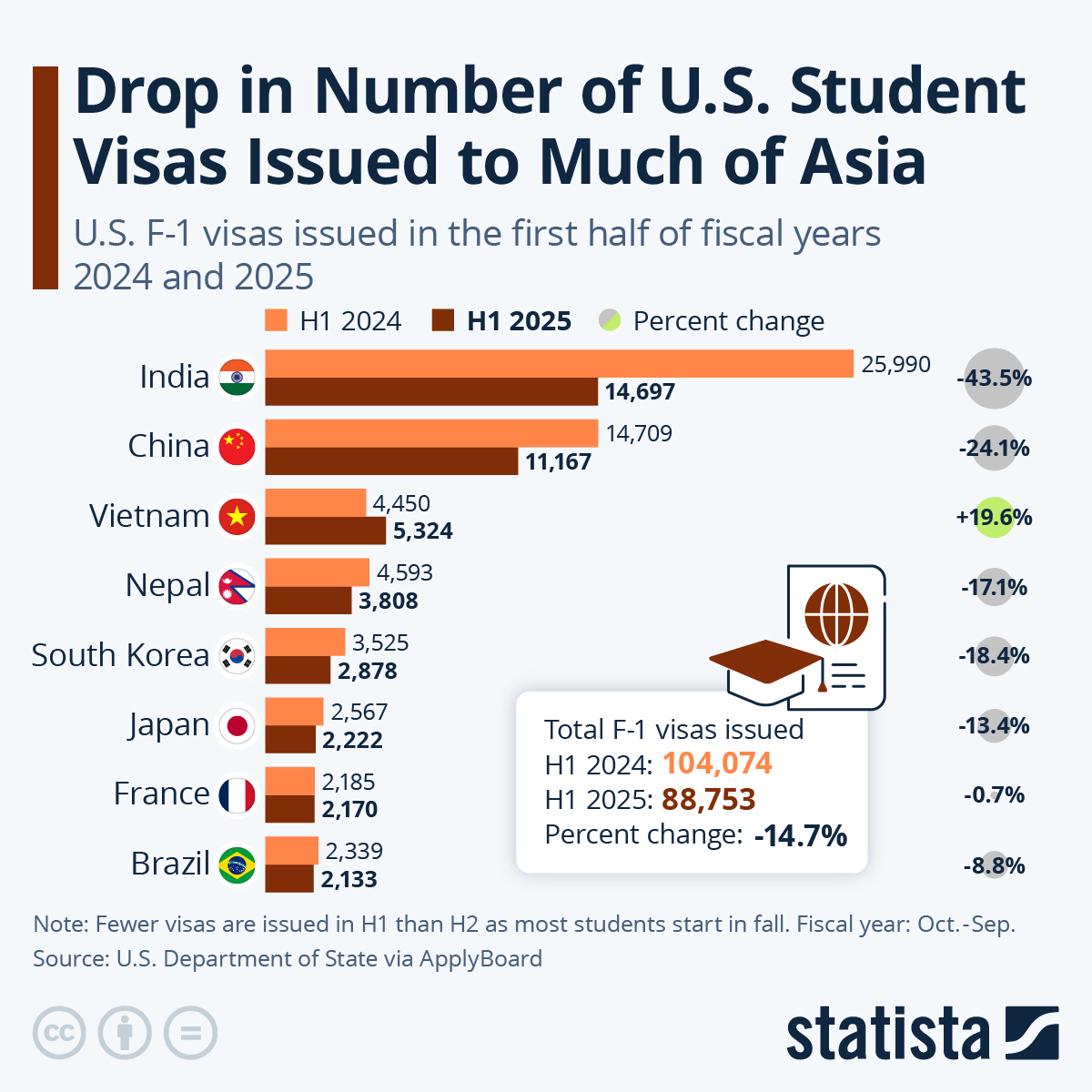
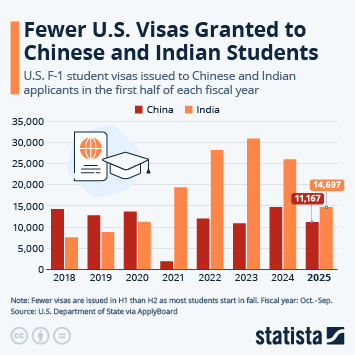
Many U.S. universities rely on higher tuition fees from international students to offset shrinking public funding. However, in the first half of FY2025, the U.S. issued only 88,753 F-1 visas, marking a 14.7 percent drop from 2024. This is according to an analysis of U.S. State Department data by ApplyBoard.
The decline was largely attributed to the State Department’s temporary suspension of visa interviews and the introduction of expanded social media screening earlier this year. When interviews resumed in June, applicants for F, M and J nonimmigrant visas were required to make their social media profiles public, with officials scrutinizing posts for signs of hostility toward the U.S. These measures raised concerns over privacy and freedom of speech. Despite backlash from some of his supporters, U.S. President Donald Trump has announced plans to now welcome 600,000 Chinese students to U.S. universities, even as policies remain restrictive.
Both India and China, the U.S.’ biggest source countries for international students, saw major declines in the number of F-1 visas between H1 2024 and H1 2025. In India, the figure dropped by as much as 43.5 percent, while in China it dropped by 21.1 percent. But as the following chart shows, several other countries in Asia also saw declines in the numbers of F-1 visas issued.
Vietnam is one of the few in the region to buck this trend, with 5,324 visas issued in H1 2025, marking an increase of 19.6 percent. According to ApplyBoard, this is linked to the country’s strong academic achievement and its expanding middle-class wealth. Bangladesh and Pakistan also saw the number of visas issued increase, to 2,098 (+20.1 percent) and 1,928 (+44.3 percent), respectively. Meanwhile student populations from several emerging populations also grew, including a 162 percent increase in visas to Zimbabwe.
Analysts note that far fewer visas are generally issued in H1 of each fiscal year, as most students start in fall. At the same time, H1 has not historically always correlated with full-year performance, as both 2022 and 2023 had lower H1 issuances but higher full-year totals. According to the latest data, there were 44,245 visas issued for the full fiscal year in 2023 and 401,007 in the full year of 2024.
This data focuses on F-1 visas which are for self-funded or institutionally funded full time academic programs. The J-1 visa is also offered by the U.S. and is for participants in exchange programs that are usually government, institution or externally funded.