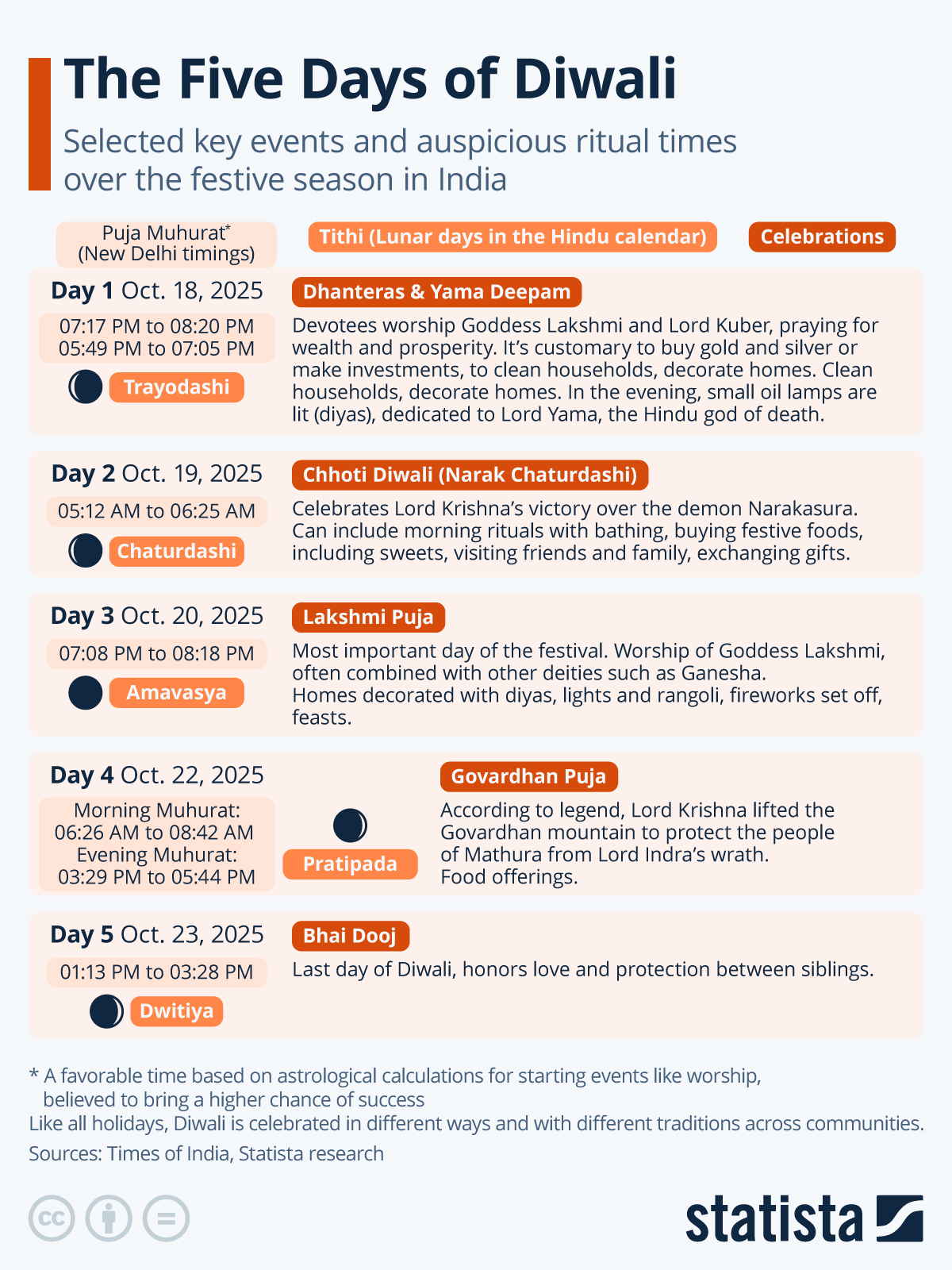
The five-day Hindu festival of lights, Diwali, kicks off this weekend, with the main event taking place on Monday. Celebrated by more than a billion people across India, Nepal, Singapore and Malaysia, not to mention communities across the rest of the world, it is one of the biggest events in Hinduism and also celebrated in Jainism and Sikhism. Diwali follows the Hindu lunar calendar, marking the darkest night of the year, and with it, the triumph of good over evil. As with all holidays, Diwali is celebrated in different ways and with different traditions across countries and even among families. This includes various interpretations, ranging from understandings of the religious stories to the timings of the specific rituals and customs.
The following chart collects together just some of these traditions and practices, as well as the recommended timings for rituals on each of the five main days, based in New Delhi, and as listed by Mahima Sharma of the Times of India. A muhurat is a unit of time in Hindu tradition, equivalent to approximately 48 minutes. The ones on this chart are auspicious (recommended) timings in which to initiate rituals, based on astrological calculations, and are believed to lead to a higher chance of success. These time periods may vary across sources due to factors such local sunrise and sunset times and different calculation methods.
The festivities kick off this year on October 18 with Dhanteras. On this day, devotees pay worship to Goddess Lakshmi and Lord Kuber. It is believed that Goddess Lakshmi blesses clean and pure houses, and so people thoroughly clean and decorate their homes with items like lamps, flowers, and rangoli (colorful patterns on the floor made from dyed rice, petals and lentils), praying in rituals for wealth and prosperity. It is also customary to buy gold and silver or make investments. In the evening, Yama Deepam is observed, dedicated to Lord Yama, the Hindu god of death. Small earthenware oil lamps called diyas are lit, in order to ward off untimely death.
Chhoti Diwali is celebrated the next day and is considered a warm-up to the main event. Also called Narak Chaturdashi, it celebrates Lord Krishna’s victory over the demon Narakasura. For some worshippers, the day may start with a morning bathing ritual. Other events include buying festive foods, especially sweets, as well as visiting friends and family, and the exchanging of gifts.
The third day, October 20 this year, is the main event when Lakshmi Puja is performed, a special ritual dedicated to Goddess Lakshmi, the Hindu goddess of wealth, prosperity and abundance. Other deities might also be worshipped this day, including Ganesha and homes are decorated elaborately with lights, diyas and rangoli. Fireworks are set off and families enjoy feasts. On this day, the important window for worship highlighted by the Times of India is between 07:08 p.m. and 08:18 p.m. According to the site Drik Panchang, Lakshmi Puja Muhurat is at 07:41 p.m. to 08:41 PM in Mumbai, 07:17 p.m. to 08:25 p.m. in Jaipur and 07:38 p.m. to 08:37 p.m. in Pune.
The fourth day, celebrates when Lord Krishna lifted the Govardhan mountain to protect the people of Mathura from Lord Indra's wrath. Finally, the fifth day is the Bhai Dooj, which honors love and protection between siblings.