Originally meant to oversee the reconstruction of Gaza - without any input from Palestinians -, Donald Trump's self-proclaimed "Board of Peace" seems to be expanding far past its intended purpose. Donald Trump, who will chair the body indefinitely, suggested on Tuesday it could "replace the UN", a statement that added to the concerns of some Western leaders.
With permanent seats up for sale for $1 billion and a “founding Executive Board” including Trump’s son-in-law Jared Kushner, Secretary of State Marco Rubio, special envoy Steve Witkoff and former British prime minister Tony Blair, the "Board of Peace"'s stated new aim is to tackle conflicts all over the world - its charter draft, which was sent to countries along with their invitation to join, does in fact not mention Gaza at all.
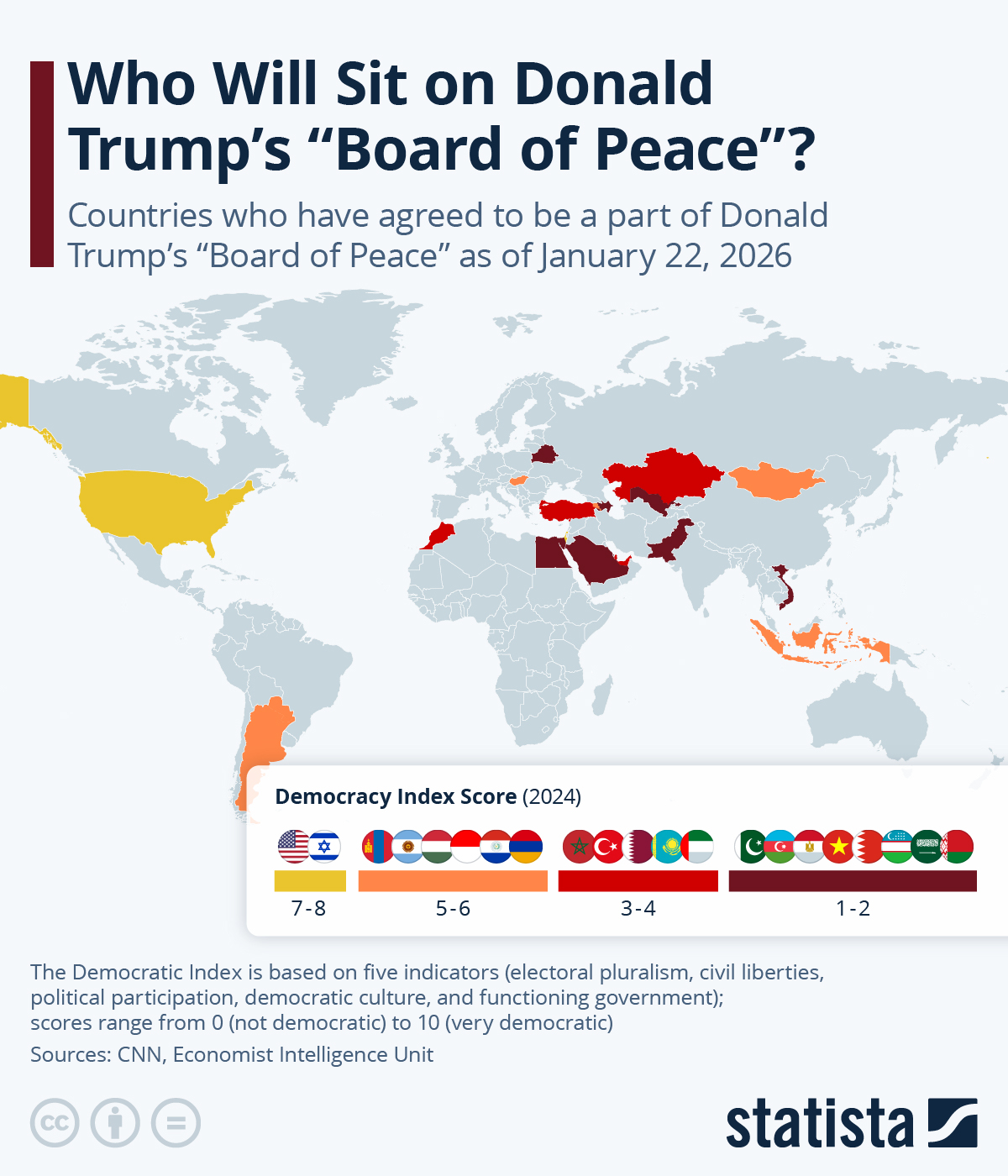
But while Donald Trump is so far facing reticence from Western leaders, many countries have already accepted a seat at the table. According to CNN, oil-rich Gulf states Bahrain, Qatar, Saudi Arabia and the United Arab Emirates have already accepted the U.S. President's invitation, as well as several Asian countries such as Indonesia, Kazakhstan and Pakistan. In Europe, two countries have so far officially accepted the invitation: Hungary and Belarus. In Latin America, Donald Trump can count on the support of his far-right ally Javier Milei in Argentina. While the U.S. President claimed earlier this week that Russia's President Putin had accepted to join the "Board of Peace", the latter clarified on Wednesday that his Foreign Ministry would "review the documents".
As our infographic shows, many of the countries that have so far decided to join Donald Trump's "Board of Peace" have a dubious track record on democracy. More than half of them scored below 5/10 in the most recent Democracy Index from the Economist Intelligence Unit, an index that evaluates the level to which a country can be considered democratic based on a selection of indicators, such as civil liberties, electoral pluralism/processes and governance. Belarus scored a staggering 1.99/10, making it an authoritarian regime. This was also the case of several others, such as Uzbekistan, Egypt, Azerbaijan and Bahrain.