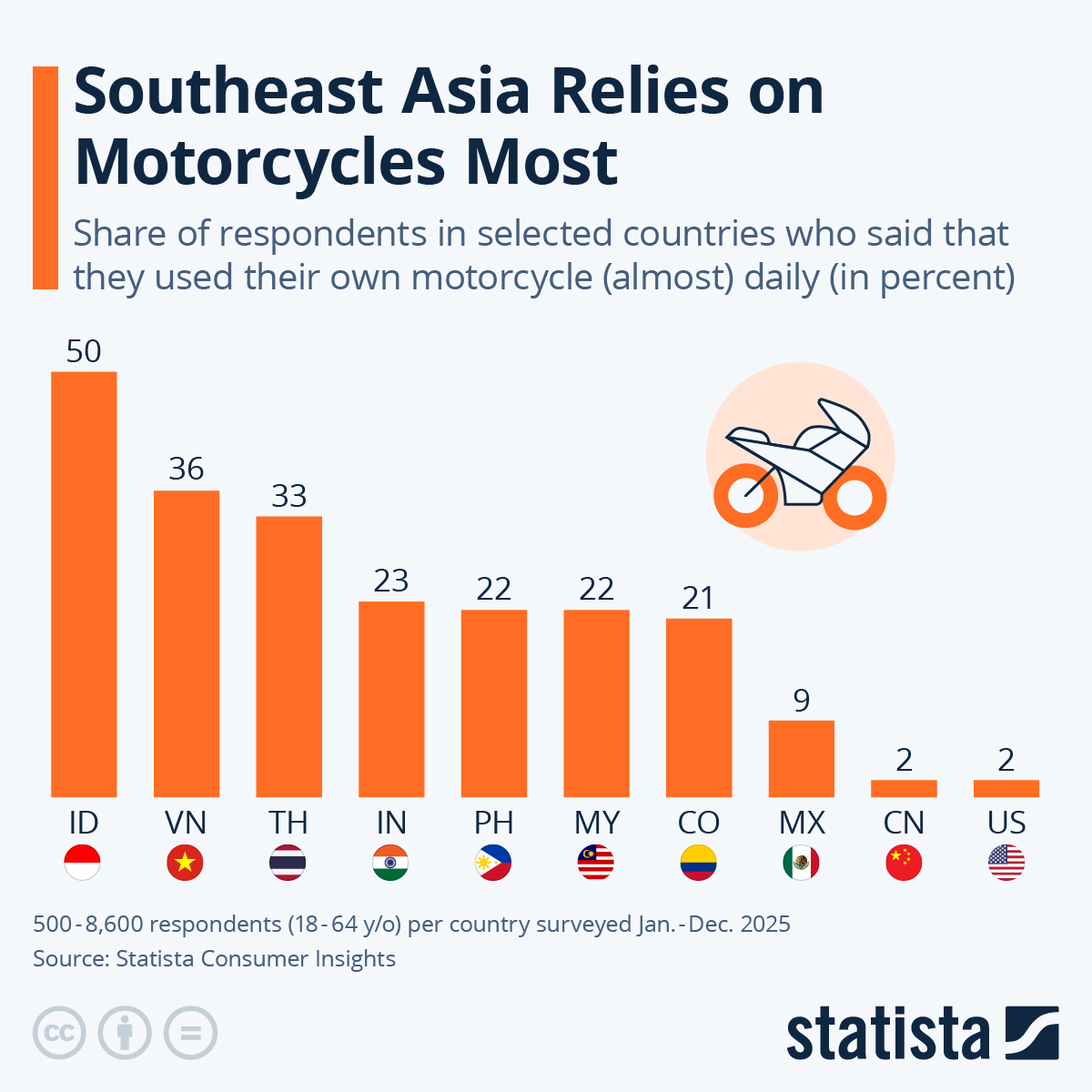
While daily or very frequent motorcycle use hovers only around 1 or 2 percent of respondents in the United States or European countries, nations in Southeast Asia rely heavily on two-wheeled motorized transport to get around. According to the Statista Consumer Insights survey, 50 percent of respondents in Indonesia, 36 percent of respondents in Vietnam and 33 percent of respondents in Thailand said they used a motorcycle they owned (almost) daily. The usage rates of men and women were very similar in Indonesia and only a little lower for women in Vietnam and Thailand.
Use was also high in India at 23 percent, the Philippines at 22 percent and Malaysia, also at 22 percent. In Latin America, the nation relying on motorcycles the most in the survey was Colombia, at near-daily use of 21 percent, while these figures were somewhat lower in Brazil (14 percent), Argentina (11 percent) and Mexico (9 percent).
Motorcycles in Asia as well as in Latin America are more often designed for ease of use and driving comfort, differing from the sporty or classic styles prevalent in Europe and North America. They even resemble scooters in their design relatively often, but are motorcycles equipped with larger engines and capable of higher speeds. On both continents, the use of motorcycles has not only made personal transport more attainable, but motorbikes are also frequently used for taxi or delivery services, making these more affordable. A recent influx of cheap, Chinese-made motorcycles as well as rising wages have even altered public transportation pattern in rural and urban Latin America.
However, increased motorcycle use also comes with its downsides. Not only do air and noise pollution rise with increased motorcycle use over public transport use, the motorcycle is also an inherently more dangerous mode of transportation than buses or cars, leading to more serious injuries and deaths among users.