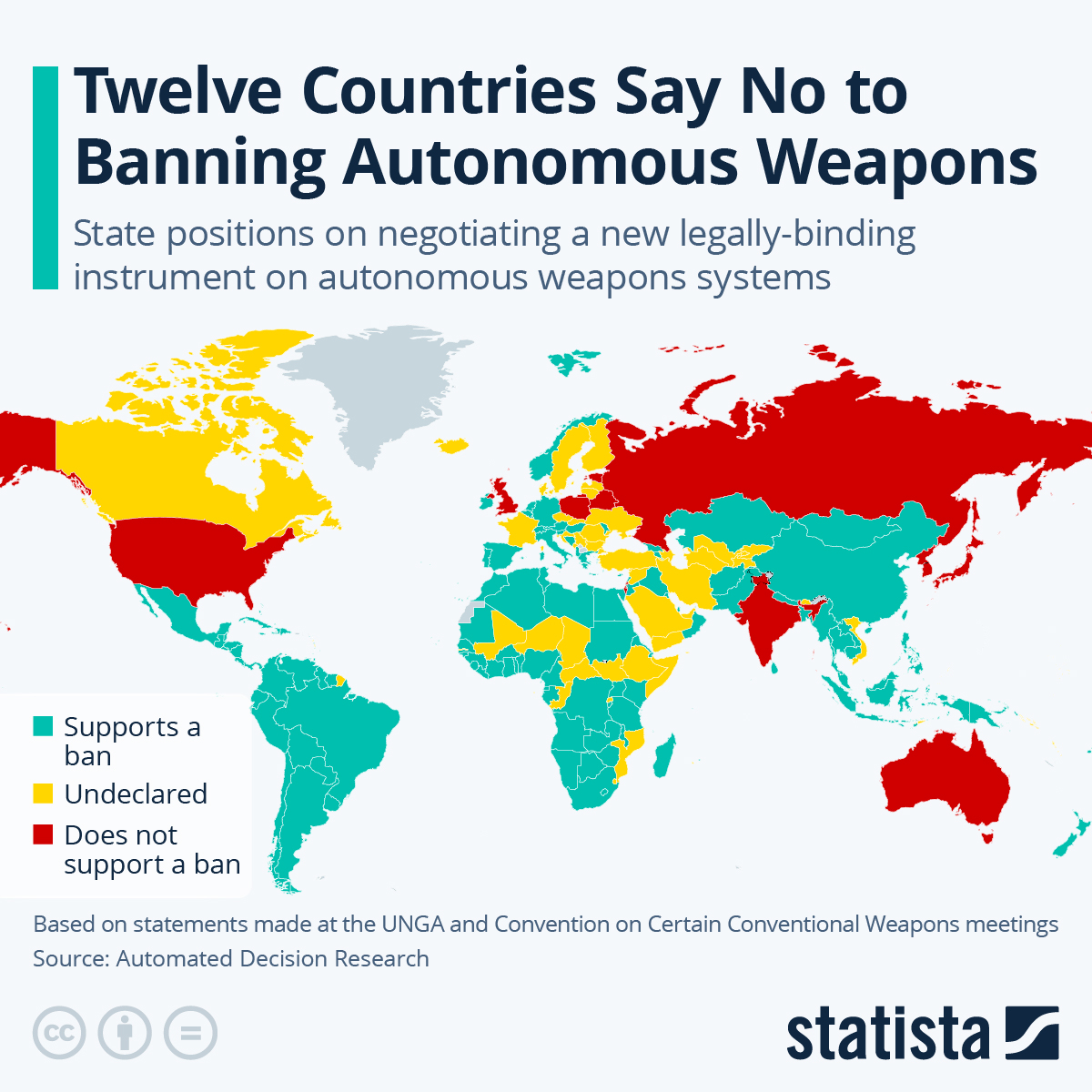
The United States and United Kingdom are among 12 countries opposing a global ban on autonomous weapons, joined by Australia, Belarus, Estonia, India, Israel, Japan, North Korea, Poland, Russia and South Korea. Data compiled by Automated Decision Research, the monitoring and research team of Stop Killer Robots, finds that another 53 nations have yet to take a clear stance, while 127 countries, including most of Africa and Latin America, support the ban. These positions have been listed following discussions at UN General Assembly and Certain Conventional Weapons meetings.
At present, there is no single law or legally-binding treaty that bans the use of lethal autonomous weapons (LAWS), which have been used in conflict zones like Ukraine and Libya. The International Committee of the Red Cross (ICRC) is calling for new international rules, citing humanitarian, legal and ethical concerns over the loss of human control in warfare, which raises issues of responsibility and accountability. LAWS pose risks to both civilians and combatants and could escalate conflicts.
Though LAWS may use AI, it is not a requirement. However, the broader debate around military AI also remains obscure. Over the past few years, several initiatives have emerged to address military AI, but none are yet legally binding. In 2024, the UN GA resolution A/79/408 saw 166 countries supporting restrictions on LAWS, while Belarus, Korea, and Russia opposed, and 15, including Ukraine, abstained. Meanwhile, two landmark intergovernmental frameworks worth mentioning include The Political Declaration on Responsible Military Use of AI and Autonomy, an initiative launched by the U.S. and supported by over 60 nations, as well as the Responsible AI in the Military Domain (REAIM) Call for Action, endorsed by more than 50 countries. Both focus on ethical guidelines but are non-binding.
The UN Office for Disarmament Affairs has condemned LAWS as "politically unacceptable and morally repugnant," and UN Secretary-General António Guterres has called for their prohibition under international law.