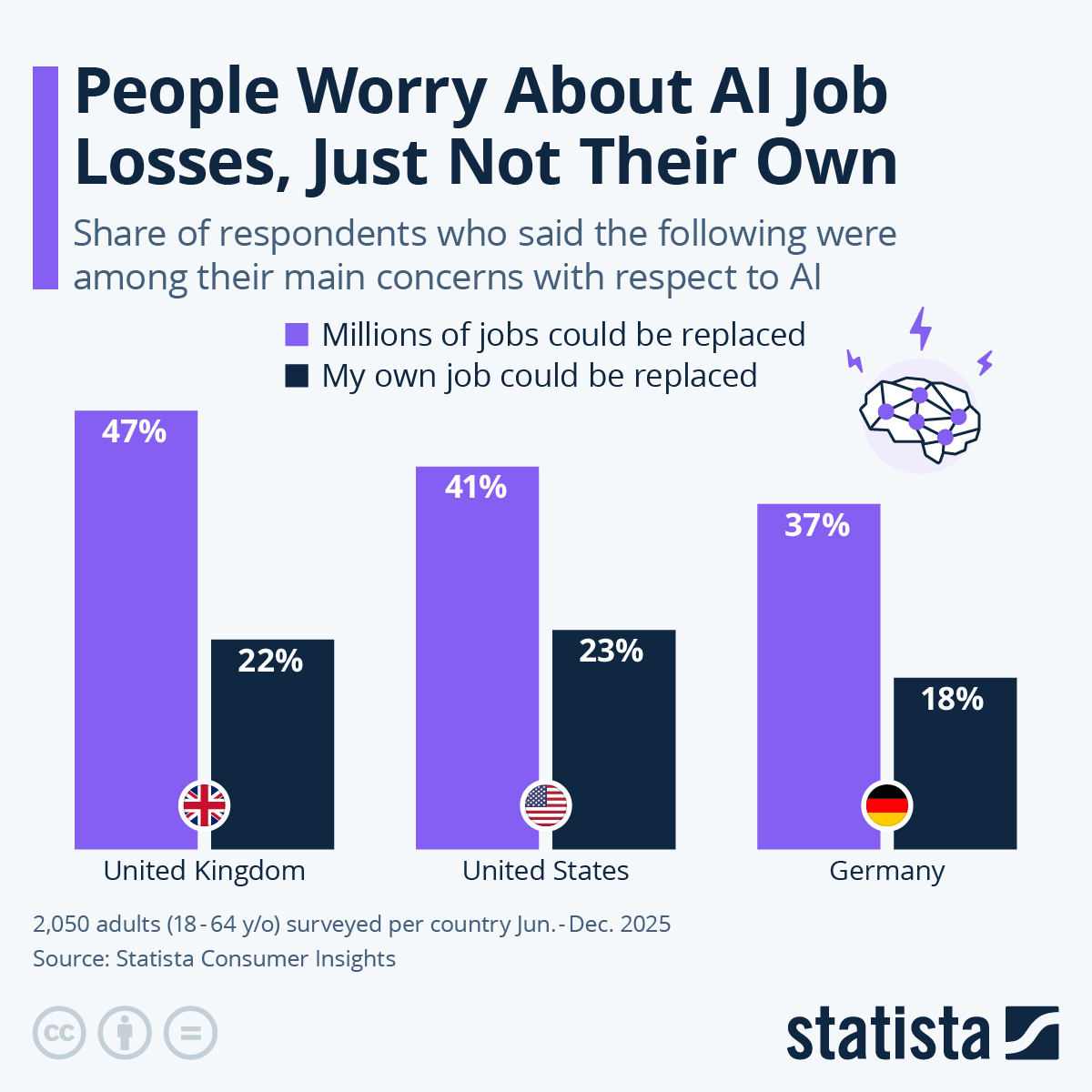
When people are asked about their main concerns regarding the rise of AI, job losses are usually high on the list. A new survey from Statista Consumer Insights reveals an interesting disconnect, however: While lots of people say they worry that AI could replace millions of jobs, far fewer think it will come for their own role. When asked to pick their main concerns with respect to AI, 47, 41 and 37 percent of respondents from the UK, the United States and Germany, respectively, said that they fear that millions of jobs could be replaced. Thinking about their own job specifically, only 22, 23 and 18 percent feared replacement by AI, though.
This gap hints at an interesting “big picture vs. personal impact” disconnect. While people clearly see AI as a force that could reshape the labor market, many feel insulated from the disruption, at least for now. Depending on your point of view, this could be interpreted as a sign of optimism, hubris (“my work is too complex to automate”) or simply of uncertainty about what AI can and cannot actually do. Either way, the numbers suggest that public anxiety is less about individual job security and more about what widespread automation could mean for society and the economy.
Looking at the biggest AI-related concerns overall, job losses come in third in each of the three surveyed markets. What people are worried about the most is misinformation and manipulation, both closely connected and both a real risk in a world in which people have not yet gotten used to the power of AI, making it hard for them to tell truth from AI-generated lies. According to an earlier survey conducted by the Pew Research Center, AI experts agree with this assessment, even though they are significantly less concerned about job losses than laypeople are.