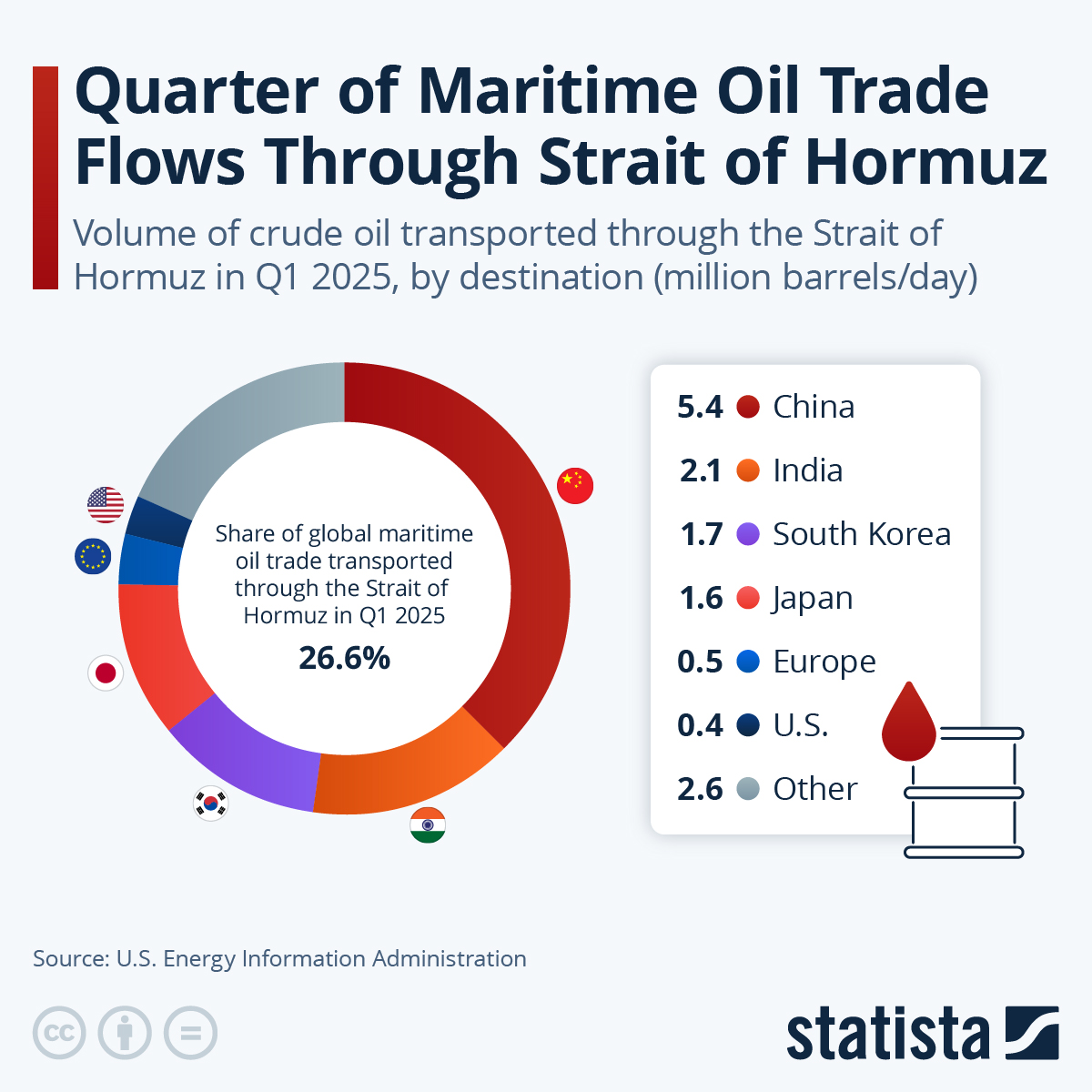
International shipping has almost come to a halt at the entrance of the Strait of Hormuz, in the south of Iran, due to retaliatory strikes across the Middle East following a series of attacks launched by Israel and the U.S. on Saturday. On Sunday, German shipping group Hapag-Lloyd said it had suspended all vessel transit through the strait until further notice. As our infographic shows, close to 27 percent of all maritime oil trade transited through the strait in the first quarter of 2025, making it one of the world's most important maritime chokepoints. The ongoing situation is already causing oil prices to rise, with brent crude jumping by 10 percent to reach over $82 a barrel on Monday according to the BBC.
Data from the U.S. Energy Information Adminisration (EIA) shows that oil flows through the Strait of Hormuz averaged 20.1 million barrels per day in Q1 2025, with crude oil accounting for around 14.2 million of those barrels. Over a third (5.4 millions barrels per day) were travelling towards China, with India, South Korea and Japan each receiving between 1.6 and 2.1 million barrels a day. The United States imported around 400,000 barrels a day through the Strait of Hormuz during that period.
While OPEC+ countries agreed on Sunday to increase their output by 206,000 barrels a day to try and offset the effects of the ongoing situation in Iran, some experts doubt this will have much of an effect. A prolonged conflict in the region would be likely to drive up gas prices around the world.