Today marks the 150th anniversary of the first telephone call, a historic moment on March 10, 1876, when Alexander Graham Bell successfully transmitted the famous words, “Mr. Watson, come here, I want to see you.” Since then, telephony has undergone several technological revolutions, reshaping how people connect and communicate. The beginning of the 21st century, in particular, has brought sweeping change, with the decline of landlines and the rapid rise of mobile phones.
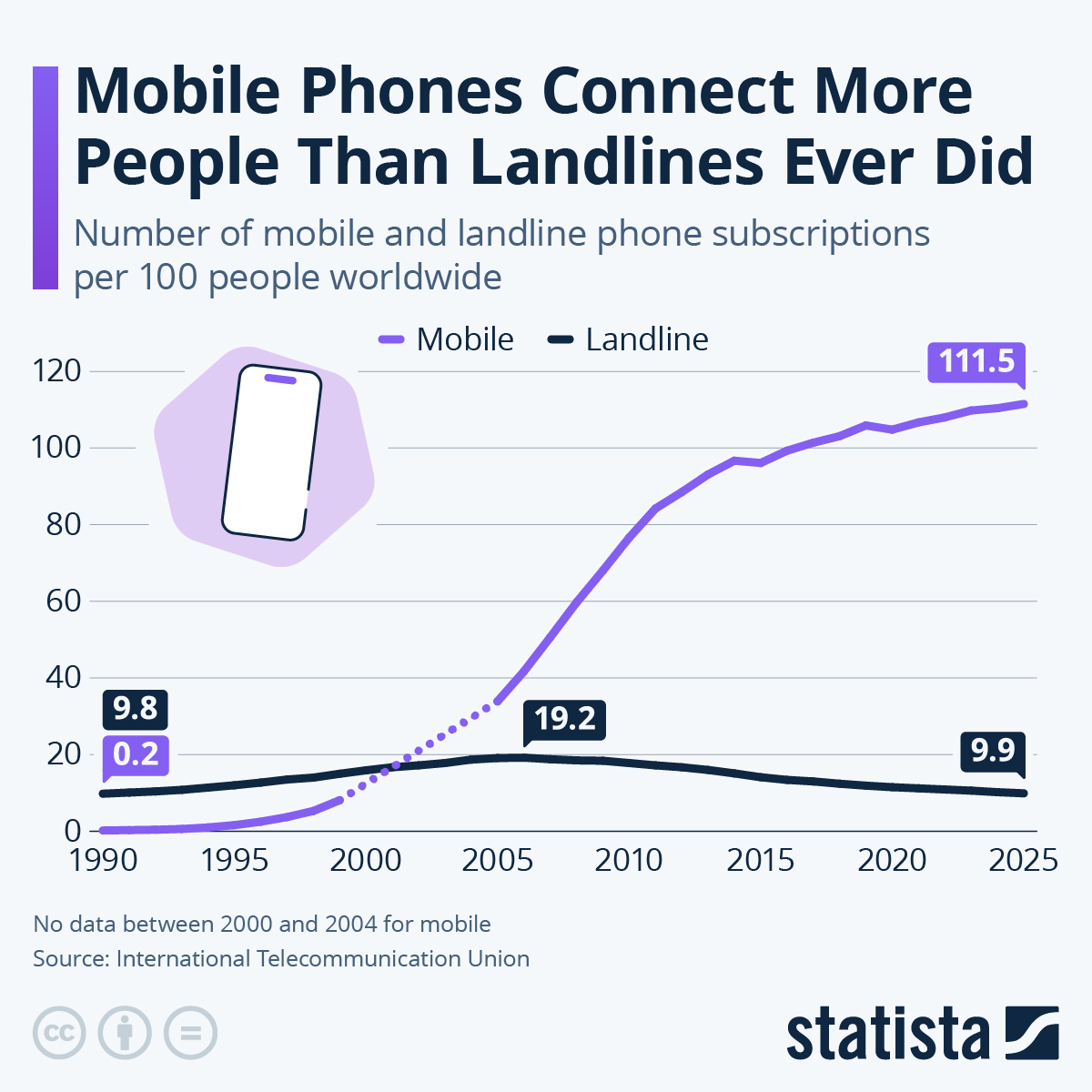
For most of the 20th century, landline telephones formed the backbone of global communications. However, the turn of the millennium marked the beginning of the decline phase for this technology. In 1990, there were 9.8 landline subscriptions per 100 people worldwide, a figure that nearly doubled to 19.2 by 2006, according to data from the International Telecommunication Union. Yet this dominance did not last. While landline subscriptions peaked in the early 2000s, mobile subscriptions began to rise rapidly. From fewer than 10 subscriptions per 100 people in 1999, mobile penetration reached 50 per 100 people by 2007 and 100 per 100 people by 2017.
Today, the numbers tell a clear story. In 2025, there are 111.5 mobile subscriptions per 100 people worldwide, compared with just 9.9 landline subscriptions (a figure that has fallen back to roughly 1990 levels). Mobile phones have not only replaced landlines but have also connected more people than fixed-line networks ever did. While significant disparities remain in terms of network technology and coverage, mobile phones have leapfrogged traditional landline infrastructure in many regions, particularly in developing countries, providing billions of people with access to the internet, financial services and important information.