Venezuela’s deposed president Nicolás Maduro is set to appear in a New York courtroom today on drug and weapons charges. Maduro was captured by the U.S. and flown out of the South American country on Saturday, following a lightning operation that took just two hours and 20 minutes.
At least 80 people were killed in the U.S. military operation, the New York Times reported on Sunday. The removal ignited a wave of responses from the international community, including condemnation from other leaders in the region and concern from UN Secretary General Antonio Guterres over whether the strikes would set a “dangerous precedent”. Many Venezuelans have responded with celebration at the hope of a new era, mixed with uncertainty over what is to come next.
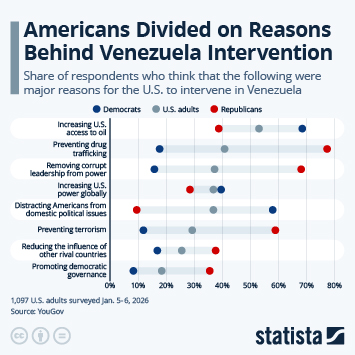
Over the past months, Washington had been expanding its presence across the Caribbean, flexing its might over the Latin American nation. While the U.S. reasoning of its intervention had initially centered on drug trafficking, as the U.S. took out multiple small boats accused of carrying illicit drugs towards the United States, Trump has since stated that he intends to gain access to Venezuela's vast oil wealth.
According to OPEC’s latest annual statistical review, Venezuela holds nearly one fifth of the world’s proven crude reserves, or an estimated 303 billion barrels. Most other major deposits are concentrated in the Middle East, led by Saudi Arabia with 267 billion barrels, Iran with 209 billion and Iraq with 145 billion. OPEC’s figures exclude Canada’s oil sands; Canadian government data puts those reserves at 171 billion barrels, which would place Canada fourth globally in 2024.
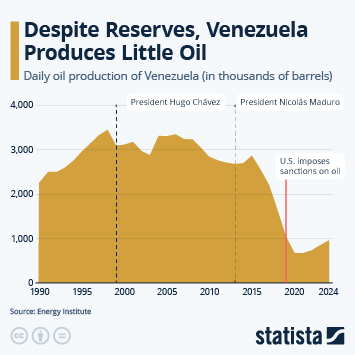
Despite its enormous reserves, Venezuela contributed only 1.3 percent of global oil production last year. OPEC data shows the top producers in 2024 were the United States (18.2 percent of world output), Russia (12.7 percent) and Saudi Arabia (12.3 percent).