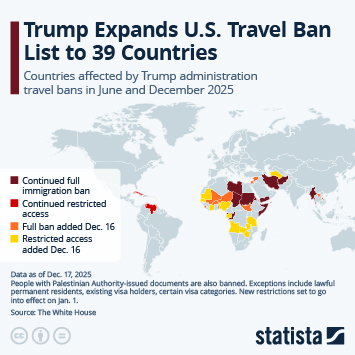
Effective Jan. 1, the U.S. government extended its so-called travel ban to 40 countries and territories, much beyond the scope of this type of ban during the first Trump administration. Added to the list were, among others, Laos, Senegal, Tanzania, Antigua and Baruda as well as Dominica, Palestine and South Sudan. By adding Syria and Nigeria to the list, Trump is also including two more countries which were part of the travel ban between 2017 and 2021. All nations are seeing all or most new visa issuing suspended in immigrant and non-immigrant categories. Not affected are those already holding visas, already in the U.S. or permanent legal residents there, even though issues at borders can nevertheless be expected.
Five countries are continuing to face partial restrictions: Burundi, Cuba, Togo, Venezuela and Turkmenistan, the latter seeing all immigrant visa issuing banned.
Trump in June signed a proclamation banning travelers from 12 countries, including those from four Muslim-majority nations he targeted with his infamous "Muslim ban" between 2017 and 2021, citing security concerns and poor local vetting. A full ban on visitors from then on applied once more to citizens of Iran, Libya, Somalia and Yemen as well as those from Afghanistan, the Republic of the Congo, Equatorial Guinea, Haiti, Chad, Sudan, Eritrea and Myanmar. The latter two countries had also received such a ban from January 2020 to January 2021, while for Sudan, visitor entries had been banned between January and September 2017 and for Chad from January 2017 to April 2018.
As part of travel bans in Trump's first term, visitor entries had also been banned from North Korea as well as from Kyrgyzstan between January 2020 and January 2021. The orders had also included partial restrictions for additional countries like bans from the visa lottery and bans on visits from government employees.
While the Trump administration said it based its selection of countries on a Department of Homeland Security report detailing visa overstay rates, human rights organizations comdemned the blanket bans, especially those on Afghan nationals, many of whom assisted the U.S. military during the recent war in the country.