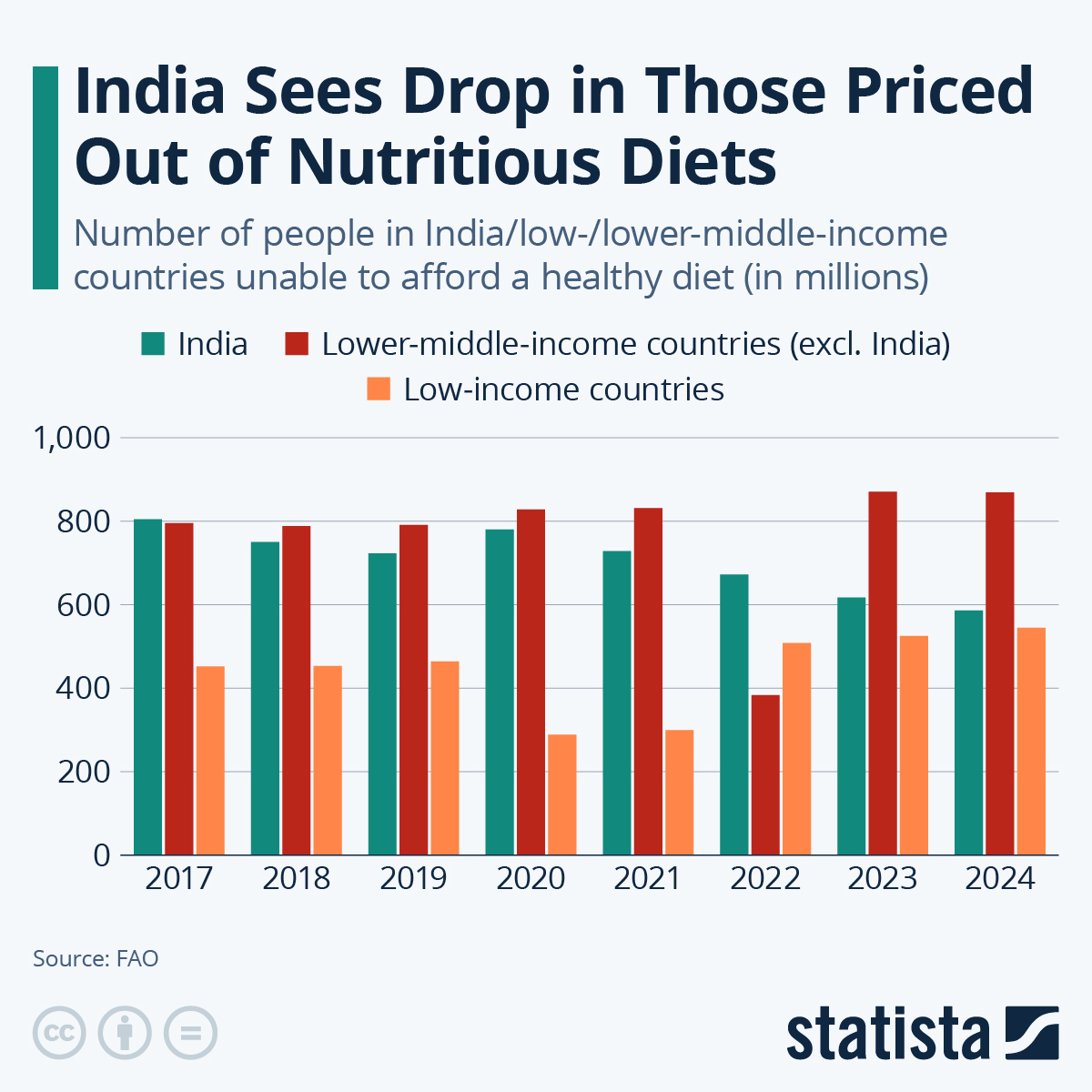
India is making strides in the number of people who have access to healthy food. Between 2017 and 2024, the number of people unable to afford a nutritious diet fell from 804 million to 586 million - a drop of more than 218 million people. This is according to a new report by the UN’s Food and Agriculture Organization (FAO), released Monday.
This drop is in stark contrast to other lower-middle-income countries around the world, which have on average seen numbers rise. In the same seven year period, figures increased from 795 million to 869 million among the income group, equating to an additional 73 million people. Last year, just over half (52 percent) of the population living in lower-middle-income countries was categorized as unable to afford a healthy diet. Among low-income countries, nearly 545 million people were unable to afford healthy meals. This represents a high 72 percent of the income group and is up 92 million people from 2017.
Despite an overall increase in food prices in 2024 and the rising trend here observed among lower-middle and low-income countries, the FAO states that overall, the number of people unable to afford a healthy diet in the world fell from 2.76 billion in 2019 to 2.60 billion in 2024. Proportionately, an estimated 31.9 percent of people were unable to afford a healthy diet in 2024, down from 33.5 percent in 2022.
Last year, the cost of a healthy diet was highest in Latin America and the Caribbean, followed by Asia, Africa, Northern America and Europe and finally Oceania.
The FAO calculates the cost of a healthy diet for each country by estimating the minimum cost of acquiring a healthy diet, defined as a diet comprising a variety of locally available foods that meet energy and most nutrient requirements. This is then compared to national income distributions in order to estimate the prevalence of unaffordability of a healthy diet and the number of people unable to afford a healthy diet.