The long-term decline in Christian affiliation in the United States appears to be leveling off, at least for now. According to Pew Research Center, the share of U.S. adults who identify as Christian has remained relatively stable in recent years, hovering at around 63 percent as of 2024, after a steady decline since at least 2007 (when Pew’s data tracks back to). By contrast, the religiously unaffiliated (those who self-identify as atheist, agnostic, or "nothing in particular”) followed the opposite trajectory. This group expanded between 2007 and 2022, before similarly stabilizing in recent years, at roughly 28 percent of the population.
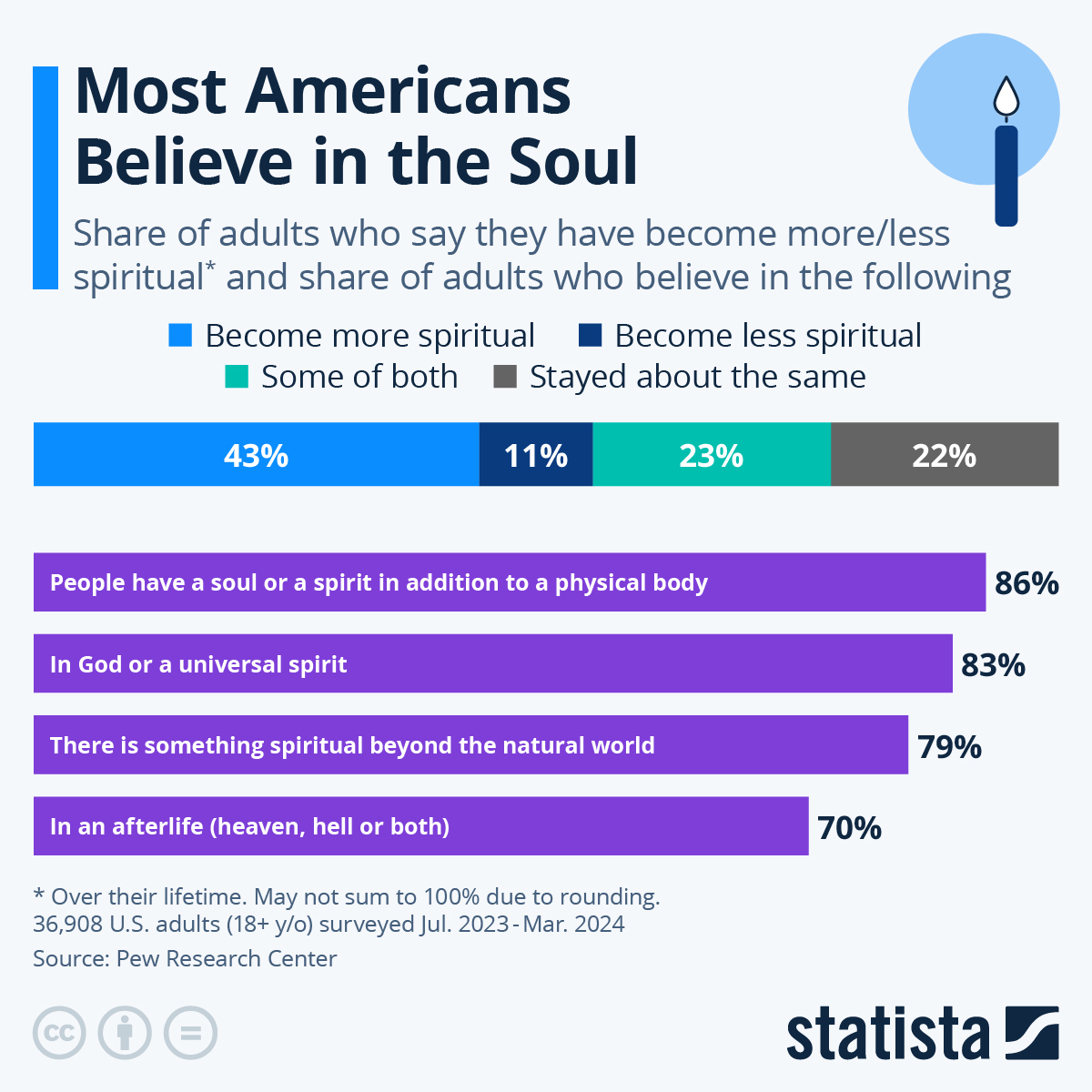
Despite the increase in the number of people who reject organised religion, belief in something beyond human beings and the natural world remains widespread in the United States. Large majorities of U.S. adults report believing in a soul (86 percent), a God or universal spirit (83 percent), something spiritual beyond the natural world (79 percent) or some form of an afterlife (70 percent).
For many (43 percent of U.S. adults), spirituality has increased over the course of their lives. This is compared to just 11 percent who said they had become less spiritual. Pew found that Americans of all ages were more likely to say their spirituality has grown as they have aged rather than it has weakened.
When Pew asked Americans the same question about how their religiousness has changed over their lifetimes, respondents were most likely to say there has been no clear change (44 percent), while similar shares reported it had increased or decreased, at 28 percent and 29 percent, respectively. Young adults were more likely to say their religiousness had decreased rather than increased, while for older adults it was the other way around.