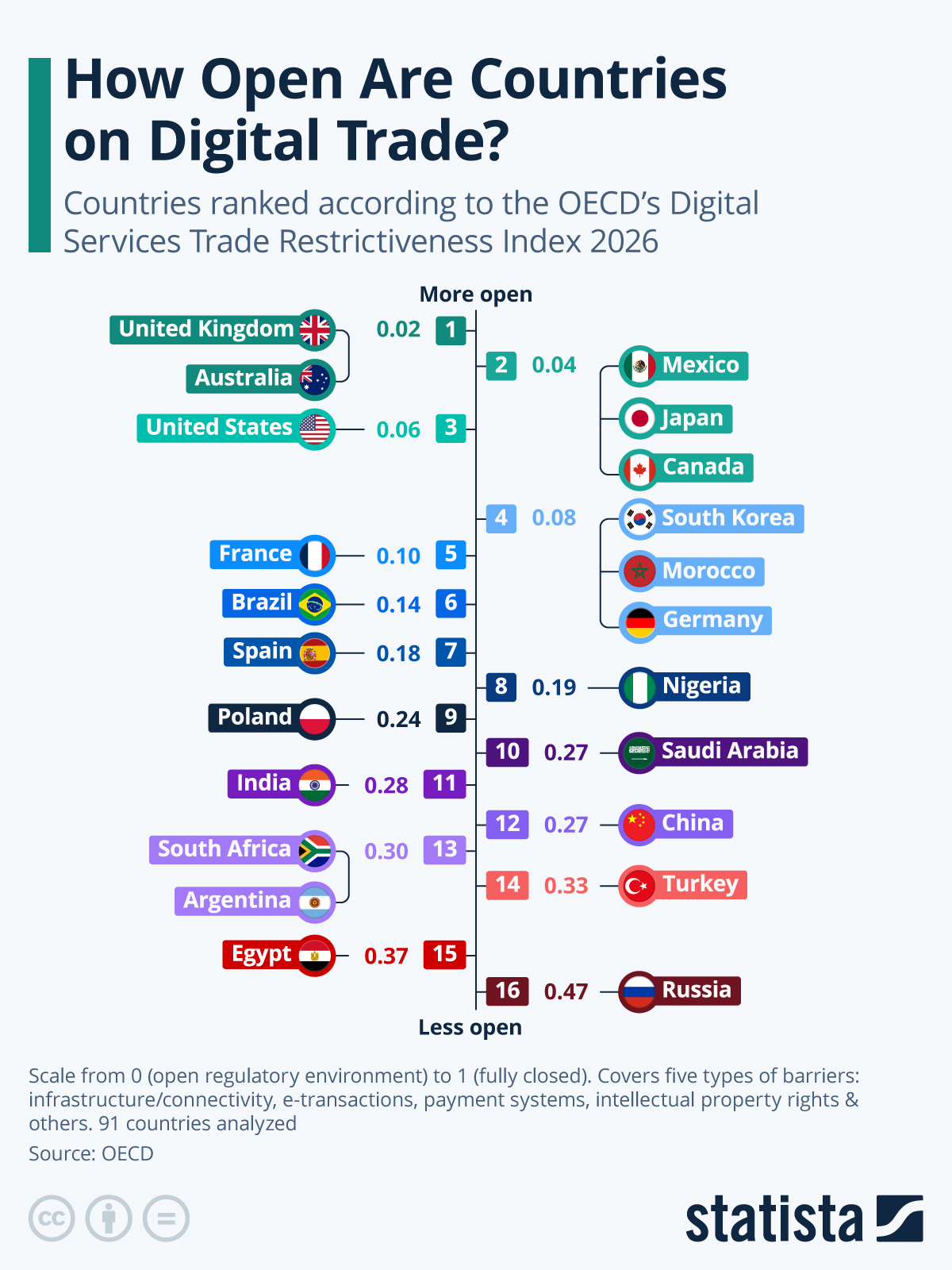
While trade in digital services has emerged as the fastest-growing segment of international commerce, the OECD’s Digital Services Trade Restrictiveness Index 2026 reveals a sharp contrast in how countries regulate digital trade. The index, which ranges from 0 (fully open) to 1 (fully closed), assesses barriers to infrastructure, electronic transactions, payment systems and intellectual property rights.
At the top of the openness scale, the United Kingdom, Australia, Norway and Switzerland lead with a score of 0.02, reflecting minimal restrictions and a welcoming environment for digital trade. Canada, Japan and Mexico also rank highly, each scoring 0.04, indicating regulatory frameworks that facilitate cross-border digital commerce. Just behind, with scores ranging from 0.06 to 0.08, are countries such as the United States, South Korea and Germany.
However, the landscape shifts dramatically as the index score moves upward. China, South Africa and Argentina, scoring between 0.29 and 0.30, face moderate restrictions, while Egypt (0.37) and Russia (0.47) are among the least open, signaling significant barriers to digital trade.
These disparities highlight the global challenge of creating a cohesive digital economy, as countries balance innovation with regulation.