When it comes to AI, we are currently seeing a weird disconnect between the companies pouring hundreds of billions into the necessary infrastructure and the broader public. While AI (cheer)leaders like Nvidia’s Jensen Huang or OpenAI’s Sam Altman rave about the possibilities of AI at every possible occasion, painting a rosy picture of the endless possibilities the AI-centric future offers, critics and large parts of the uninitiated public still harbor a healthy dose of skepticism regarding said future.
Both Altman and Huang have recently expressed their surprise/disappointment over what they perceive as lacking enthusiasm about AI’s advances. Altman said at the CISCO AI Summit earlier this month that he was surprised enterprises weren’t jumping on board quicker, given what is possible in terms of automation of a lot of tasks already. Mr. Huang went one step further, calling the “doomer” and “science fiction narratives” “extremely hurtful”. He seemed genuinely baffled by the fact that “well-respected people” would talk to governments, asking for regulation of AI.
According to a recent survey conducted by the Pew Research Center, part of the answer lies in the public perception of AI, with people seeing a lot of risks that come with the new technology and fewer obvious benefits. What Altman paints as a rosy future – automation of many research and economic tasks – sounds like a threat to many people. After all, if AI does most of their work, what will they be doing to make money? Altman and Co. have so far failed to answer that question satisfactory.
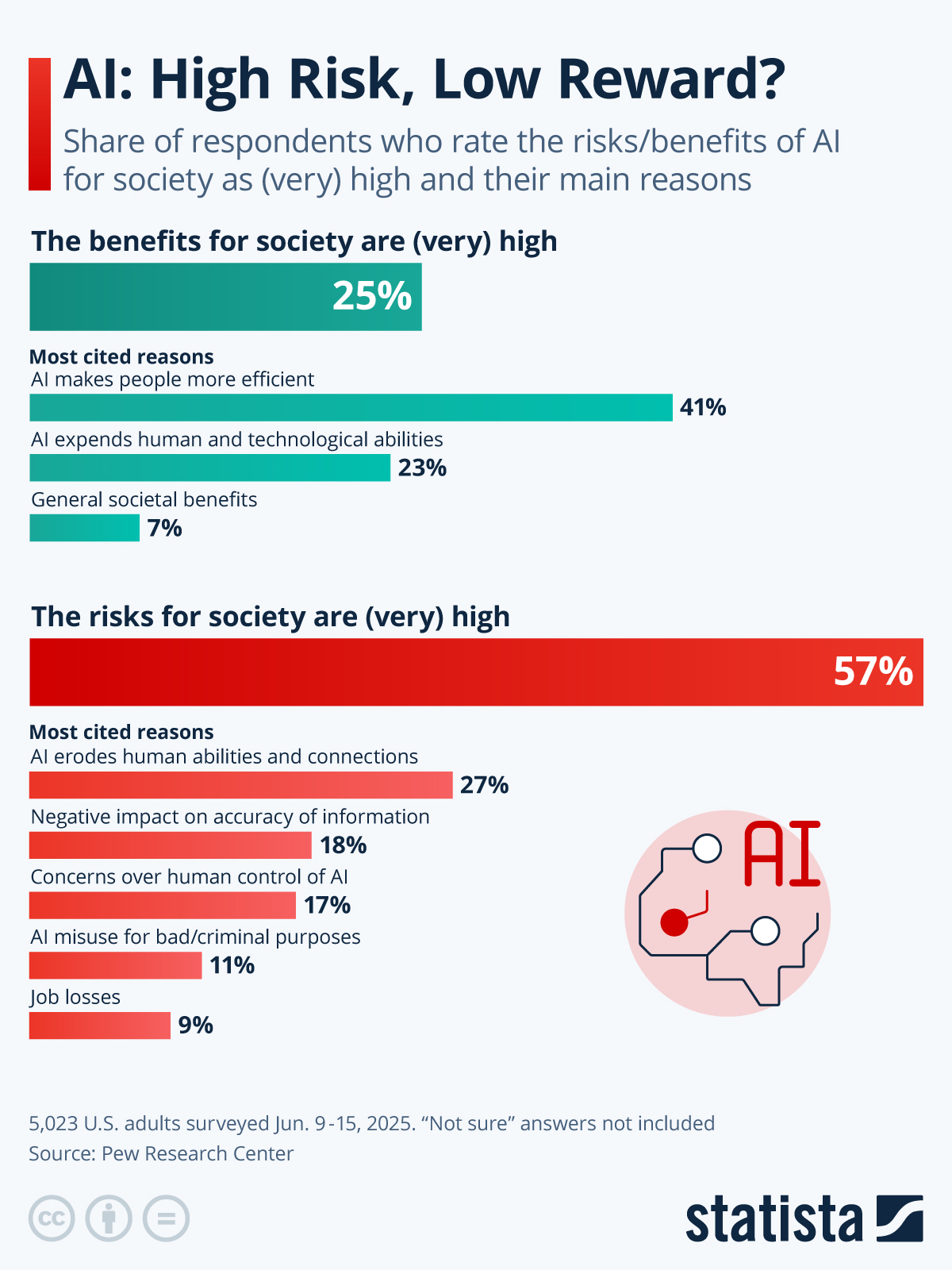
Pew found that 57 percent of the 5,000 surveyed Americans think that AI comes with big or very big risks for society, while only 25 percent of respondents think the benefits will be high or very high. Among those who rate the risks as high, the erosion of human abilities and connections tops the list of concerns, followed by the negative impact on accuracy of information and the question of whether humans will be able to control and regulate AI effectively. Interestingly, job loss is only fifth on the list, despite the potentially disruptive force of mass automation.
At the other end of the risk-reward scale, those who see big benefits for society are mostly looking towards efficiency gains brought by AI. “AI takes mundane tasks that often waste talent and effort and allows us to automate them,” one respondent said, with another one saying that “AI has the potential to make society more efficient than ever.” The second most cited reason to rate AI’s potential benefits as high is its potential to expand human and technological abilities, especially in science and health care.