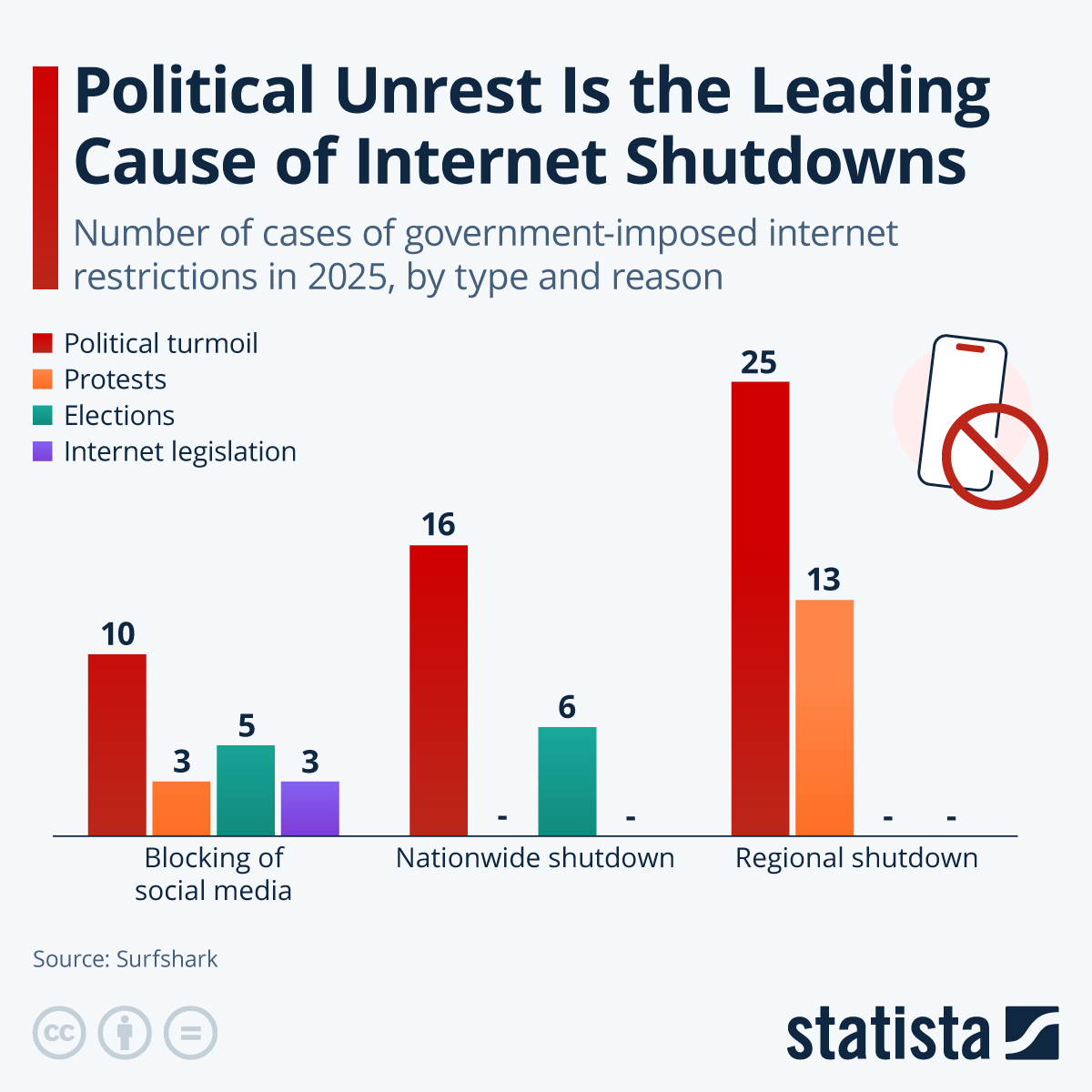
Governments around the world continued to impose restrictions on internet access in 2025, often in response to political tensions and public unrest. According to data from Surfshark, political turmoil was by far the leading cause of such measures last year. As our chart shows, 25 regional internet shutdowns and 16 nationwide shutdowns were linked to political instability, along with 10 cases involving the blocking of social media platforms.
Protests were another major trigger. Authorities imposed 13 regional shutdowns and three social media blocks in response to demonstrations. Elections also played a role, particularly when governments sought to control the flow of information during sensitive political periods. In 2025, six nationwide shutdowns and five social media blocks were linked to election-related concerns.
These measures include actions such as blocking websites, restricting social media platforms or messaging services and imposing regional or nationwide internet shutdowns. Many of these restrictions were concentrated in Asia and Africa. Governments in ten Asian countries introduced 56 new restrictions in 2025, while eight African countries accounted for another 20 cases. India recorded the highest number of incidents, imposing 24 restrictions during the year, often linked to political unrest or protests. Other countries reporting multiple incidents included Iraq, Afghanistan and Iran, where authorities repeatedly limited internet access during periods of tension or demonstrations.