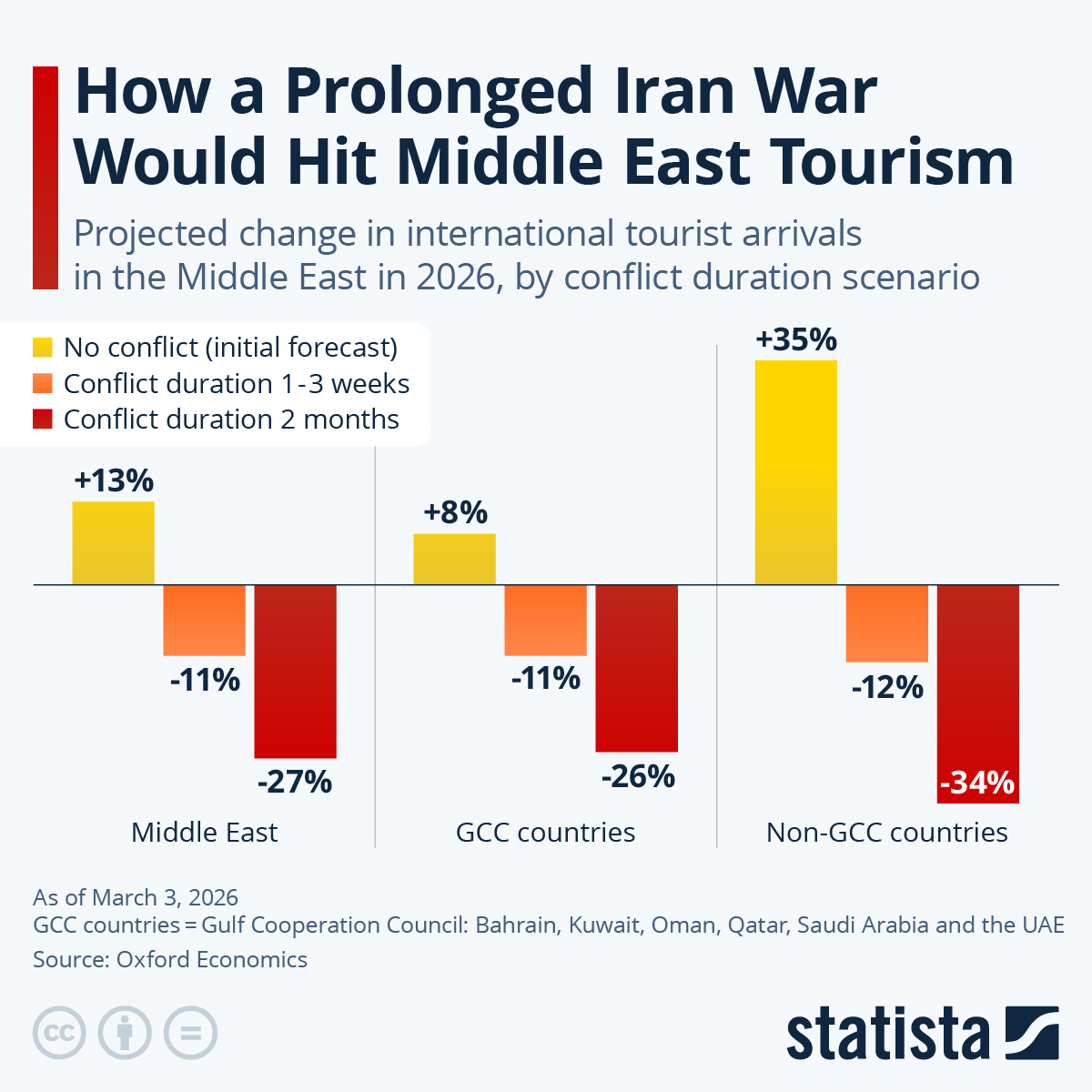
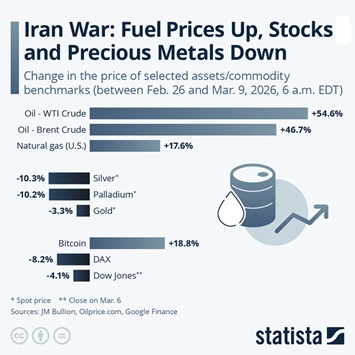
The war in Iran could abruptly halt the expected growth of tourism in the Middle East this year. In the absence of conflict, initial forecasts suggested that international tourist arrivals in the region would increase by 13 percent in 2026. However, with hostilities ongoing, a significant decline is now likely: in the event of a conflict lasting one to three weeks, arrivals could fall by 11 percent, while a two-month escalation could lead to a drop of as much as 27 percent over the year. The anticipated upswing would thus turn into a noticeable downturn. The forecasts, published on March 4, are from Tourism Economics, a division of Oxford Economics specializing in travel and tourism markets.
The impact could vary widely across the region. In the GCC countries, the expected growth of 8 percent could be replaced by a decline of up to 26 percent. Non-GCC countries, meanwhile, would be hit particularly hard: instead of a projected increase of 33 percent, they could see declines of up to 34 percent in the event of prolonged disruption. The GCC (Gulf Cooperation Council) includes Bahrain, Kuwait, Oman, Qatar, Saudi Arabia and the United Arab Emirates.
Beyond security concerns, air travel in particular is likely to weigh on the tourism sector. Closed or restricted airspace, flight cancellations and rerouting could increase travel times and costs. At the same time, uncertainty among travelers may dampen demand and further delay the recovery of international tourism in the region.