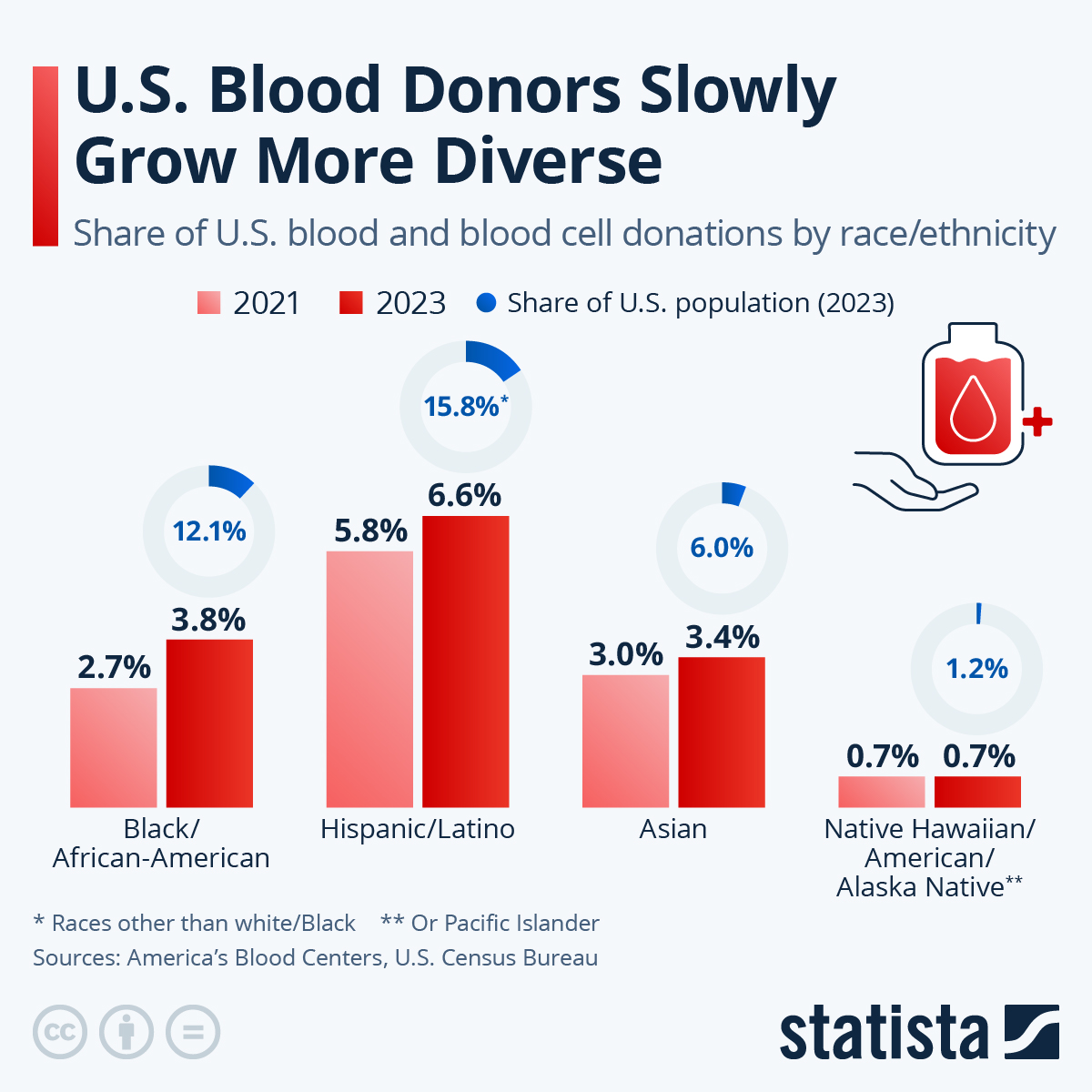
The share of Black, Latino and Asian-Americans among blood donors is slowly rising, data published by association America's Blood Centers shows. However, rates still stayed behind population shares in 2023 as barriers like lack of outreach, lack of access to donation centers and medical mistrust persist. Depending on the ethnicity, medical factors might also cause higher rates of ineligibility to donate, for example a higher prevalence of specific diseases affecting the blood or a higher likelihood of time spent in areas where certain diseases are more common.
This is despite the fact that blood from certain races or ethnicities is specifically sought after in fighting diseases common in them. This is the case for sickle cell disease, prevalent in African-Americans and other Black populations. Blood from Black donors who do not have sickle cell is needed for patients who do, as their specific blood markers and subgroups are more likely to fit patients.
As outreach and trust issues persist to the present day, racial discrimination also has a long history in blood donations. During the time of segregation, the American Red Cross used to also separate blood donations by race, leading to civil rights groups calling for a boycott. Some medical providers find it necessary to inform the public on the general compatibility of donor blood across races to this day.
While new numbers on the rates of donations by country are expected later this year, the World Health Organization has said that the blood donation rate was 31.5 per 1,000 people in high-income countries, 16.4 donations in upper-middle-income countries, 6.6 donations in lower-middle-income countries and 5.0 donations in low-income countries. While the recommended model of voluntary donations is expanding across the globe, a minority of countries still relies paid donors or family needing to provide a donor for patients for around half of their supplies. June 14 marks World Blood Donor Day.