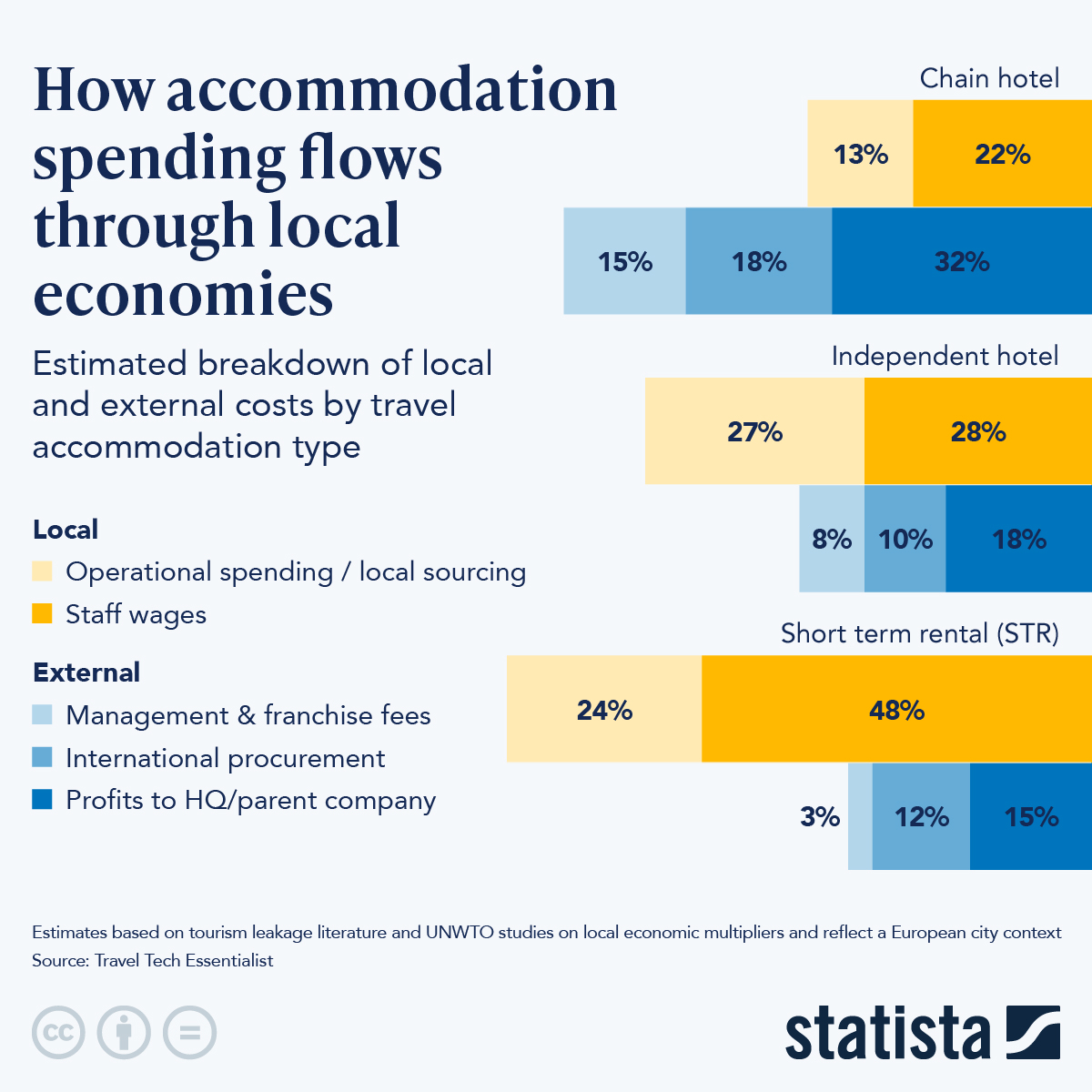
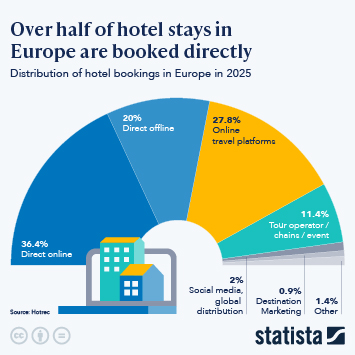
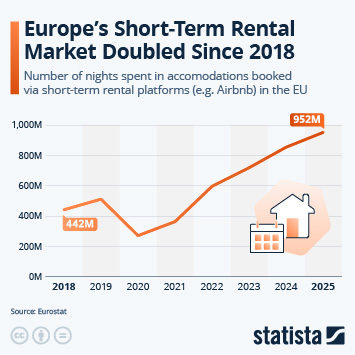
Not all accommodation spending creates the same economic benefit. Where a traveler stays, and the type of accommodation they choose, fundamentally shapes how much of their spending remains in the local community. As a rule, the smaller the business, the greater the local impact. Data collected by Travel Tech Essentialist based on UNWTO data estimates that 35% of every dollar spent at a chain hotel flows into the local economy, primarily through staff wages and locally sourced supplies. That share rises to 55% for independent hotels and to 72% for short-term rentals (STRs).
When a guest stays in a chain hotel, a significant portion of their spending flows to corporate headquarters, franchise fees, and centralized procurement. When they stay in an independent hotel or with a local STR host, more of that spending remains in the community. Locally generated income stays in the city and the visitor tends to buy coffee around the corner, groceries at the market, dinner at a place without a tourist-menu prix fixe.
The same principle applies to goods, tours, and experiences. Those produced and managed within the destination return a greater share of their profits to the community. A Civic Economics study, zooming in on Salt Lake City, found that almost four times as much revenue was returned to the community when goods were purchased at a local retailer instead of a national chain. This distinction matters because tourism's long-term value depends not only on how much visitors spend, but also on where that spending ultimately ends up.
Want more tourism insights like this? Sign up to Statista and Booking.com's monthly travel and tourism newsletter here!