The World Day of Decent Work, observed on October 7, is an annual event where trade unions and workers’ organizations advocate for fair wages, safe working conditions, social protection and the right to collective bargaining. According to the International Labour Organization, decent work is “productive and delivers a fair income, security in the workplace and social protection for families, better prospects for personal development and social integration.”
Unions are crucial vehicles for many workers around the world to be able to achieve decent work, acting as a collective voice to negotiate better terms. Trade and labor union membership has been falling in the United States over the past couple of decades, dropping from a labor union density of 20.1 percent back in 1983 to just 9.9 percent in 2024, according to the Bureau of Labor Statistics. Reasons for the decline include periods of economic prosperity that resulted in unions being deemed unnecessary in some instances, technological and organizational changes, globalization, policy reform and the decline of the manufacturing sector.
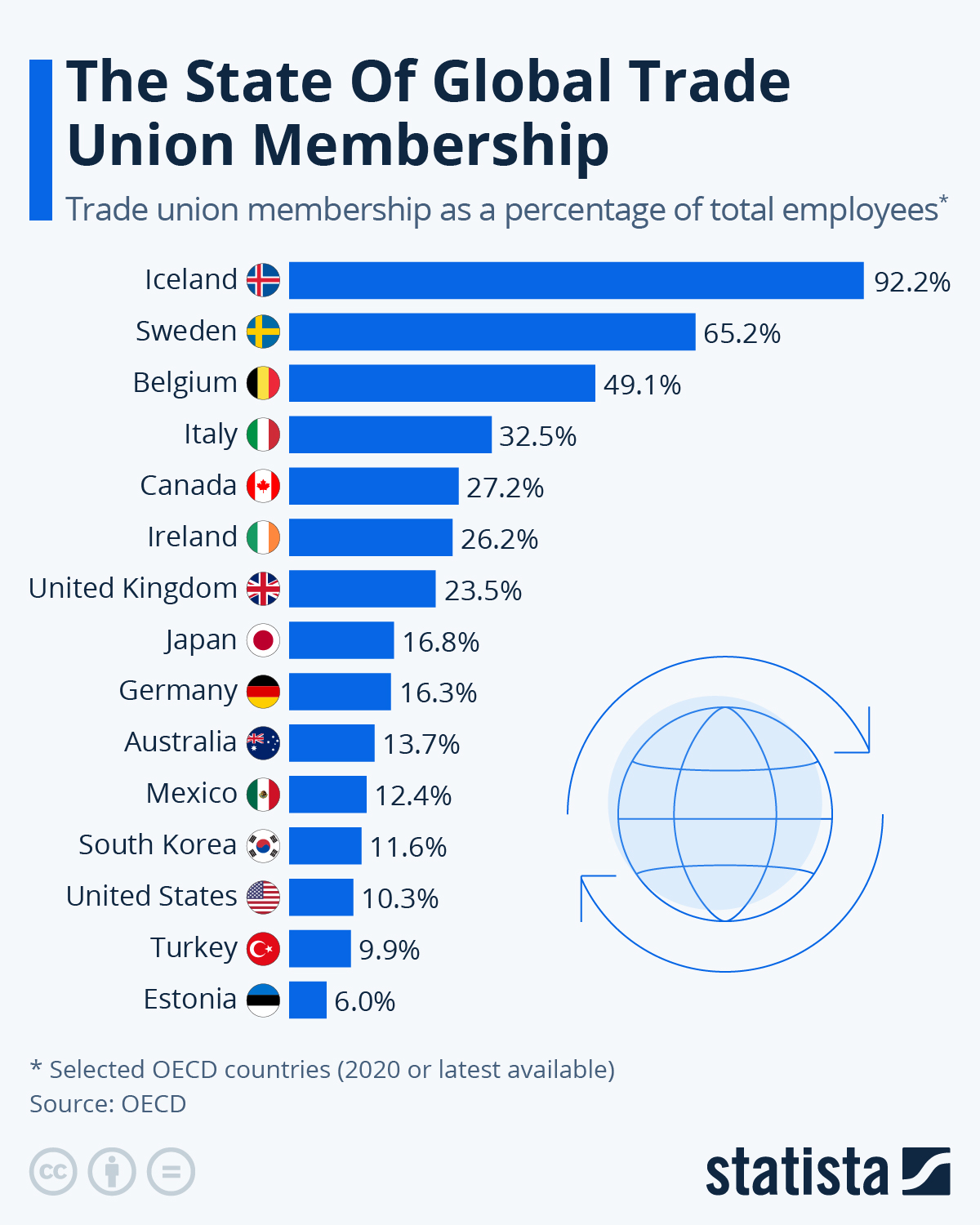
Data from the OECD shows that union membership density varies considerably between countries. Iceland had the highest rate of membership in 2024 at 90.6 percent, according to the most recent international comparison by the OECD. Scandinavia has a long history of trade unions, reflected in the fact Denmark and Sweden have the world's next-highest rates of more than 60 percent membership each. The OECD average was 15.2 percent in 2024.