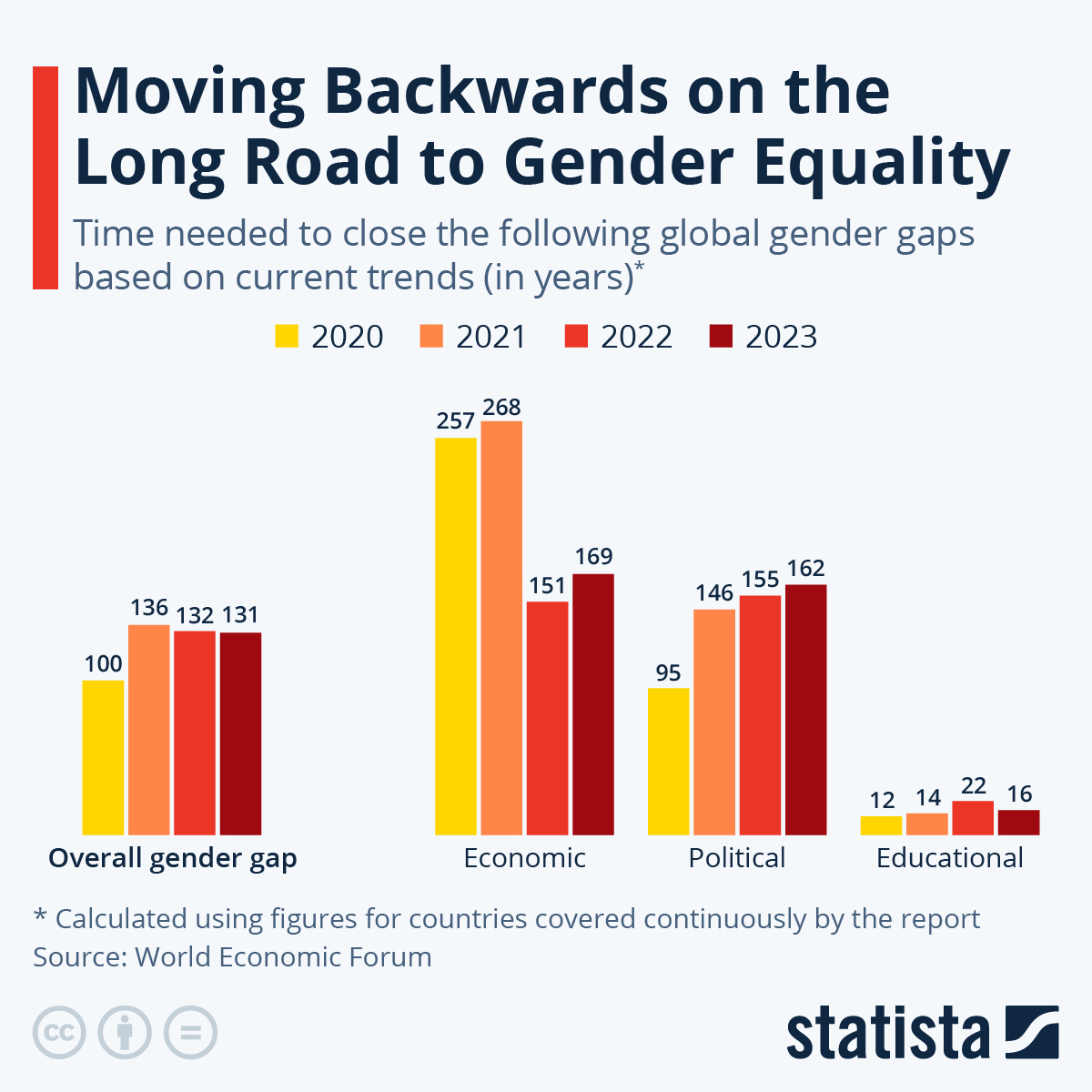
While the 2025 Global Gender Gap Report by the World Economic Forum finds that the pace of gender parity attainment has picked up, the road there hasn't been without setbacks. While the overall index is progressing now, the time to close the world's gender gaps would still be 123 years at the current pace. If this wasn't enough bad news already, some parts of the index are currently moving forward, but are only recovering from recent backsliding.
Between 2024 and 2025, the index for political empowerment improved from a gender gap close time of 169 years to 162 years. However, in 2021, it had stood at only 146 years. Going back further, the gap is still narrower now than two decades ago, moving from 14.3 percent closed in 2006 to 23.4 percent closed this year. According to the report, female heads of state experienced shorter tenures, while the overall number of women in parliament increased. The political subindex is the one with the biggest gender gap as part of the research. The economic participation and and opportunity subindex, on the other hand, made significant gains as it changed its trajectory in 2022 after a period of regression and stagnation previously.
The eductional gap is the smallest and is expected to be closed in 17 years at the current rate. However, in 2021, this had been 14 years and the subindex, despite its small gap, has been slower to progress than others. Saadia Zahidi, managing director of the World Economic Forum, said that the findings meant that most economies were not fully leveraging thier growth pathways by not fully involving women.