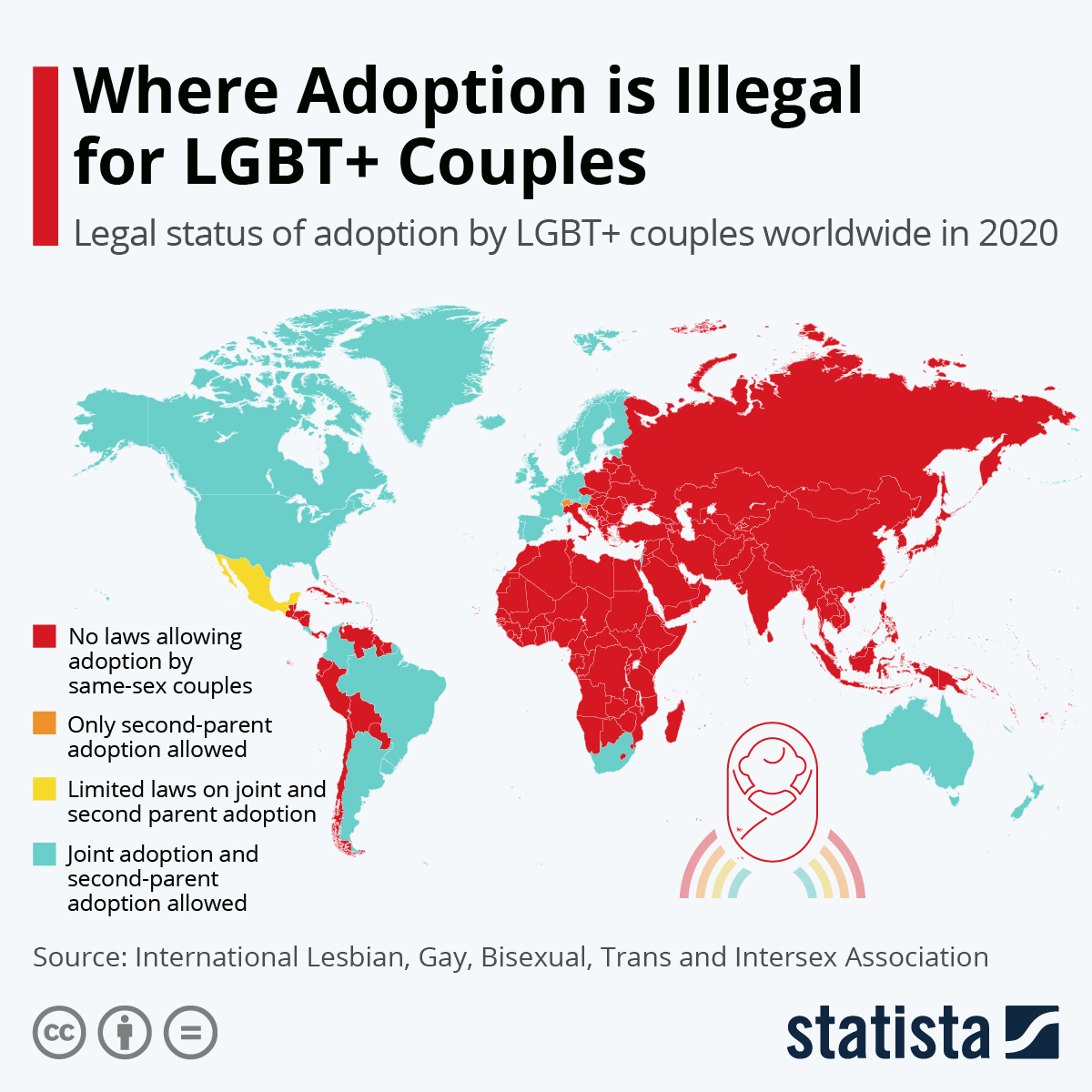
In many countries, it is still illegal for members of the LGBT community to adopt and foster children. The following map uses data from the International Lesbian, Gay, Bisexual, Trans and Intersex Association (ILGA World) to show where joint adoption and second-parent adoption are allowed, along with the countries where there are no laws allowing same-sex couples to adopt.
A joint adoption is when a couple adopts a child who was not previously the legal child of either partner. A second-parent adoption, however, is when a partner, who is not biologically related to the child, adopts their partner's biological or adopted child. As the following chart shows, a more open stance on adoption rights can be seen across Western Europe and North America, where at least some form of adoption is permitted. While most of the region’s countries support both kinds of adoption, in San Marino, only second-parent adoption is allowed. Eastern Europe is far more restrictive.
South America shows more of a mixed picture with Brazil, Argentina, Uruguay and Colombia all supporting the continent’s more progressive laws, as Bolivia, Peru, Ecuador and Venezuela deny them. In the case of Mexico, there is no federal law allowing for joint or second-parent adoption by same-sex couples. And while adoption would virtually be available in all states that recognise same-sex marriage, the lack of specific legislation creates legal uncertainty and often impedes the access to adoption rights by same-sex couples. Meanwhile, South Africa is the only country in Africa to support both kinds of laws, according to ILGA.
This map reflects the ILGA’s latest data, which is from 2024.