More than 800 people have been killed and 2,800 left injured in the eastern provinces of Kunar and Nangarhar of Afghanistan by a 6.0-magnitude earthquake on Sunday night. The latest figures are according to Taliban authorities, with the death toll expected to rise. The quake’s epicenter was shallow, at around 6 miles (10km) beneath the surface. These types of earthquakes tend to be particularly destructive.
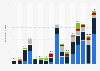
As the following chart shows, major earthquakes are not unknown to the region. This is because the country sits at the meeting point of the Arabian, Indian and Eurasian tectonic plates. As the plates move past each other, friction can build up, eventually jolting and causing the earth to move.
Even with the preliminary figures, Sunday night’s quake was among the deadliest the country has seen in the past three decades. Before that, Afghanistan was struck by two 6.3-magnitude quakes near Herat in October 2023, when the U.S. government’s National Centers for Environmental Information (NCEI) reported that 1,482 people had been killed, as the Taliban had reported closer to 4,000 deaths. Just one year prior, in 2022, at least 1,000 people were killed in a 5.9 magnitude earthquake near Afghanistan’s border with Pakistan. According to officials, the terrain in the mountainous and fairly remote region as well as weather had hampered rescue efforts.
The country’s deadliest earthquake in the past three decades was in Takhar in 1998, having killed 4,700 people. The region had been hit only three months earlier by an earthquake measuring 5.9 in magnitude, which is reported to have claimed the lives of between 2,300 and 4,000 people, according to the NCEI. Fatalities were counted not only in Afghanistan, but also in neighboring Pakistan and Iran and India.