Founded 30 years ago, on September 3, 1995, by Pierre Omidyar as “AuctionWeb”, eBay, as it would be renamed two years later, quickly became a poster child of the dot-com era. The idea was simple yet revolutionary: an online marketplace that allowed individuals to auction goods to the highest bidder, enabling sellers to find a buyer for pretty much anything. By the late 1990s, eBay had become one of the internet’s first great success stories, expanding internationally and going public in 1998, one year after fellow dot-com darling Amazon.
30 years later, both companies are still around. And while they both played a key part in reshaping the retail landscape, they eventually took dramatically different trajectories. While eBay largely stayed in its lane and remains a popular, profitable marketplace, that is relatively modest in scale, Amazon relentlessly reinvested in infrastructure, logistics and technology, evolving from an online bookstore to the world’s second largest retailer, whose business expands far beyond online retail. Its highly profitable cloud infrastructure arm AWS in particular fueled and funded much of Amazon’s growth over the past decade, turning the world’s leading online retailer into a vertically integrated tech behemoth and one of the most valuable companies in the world.
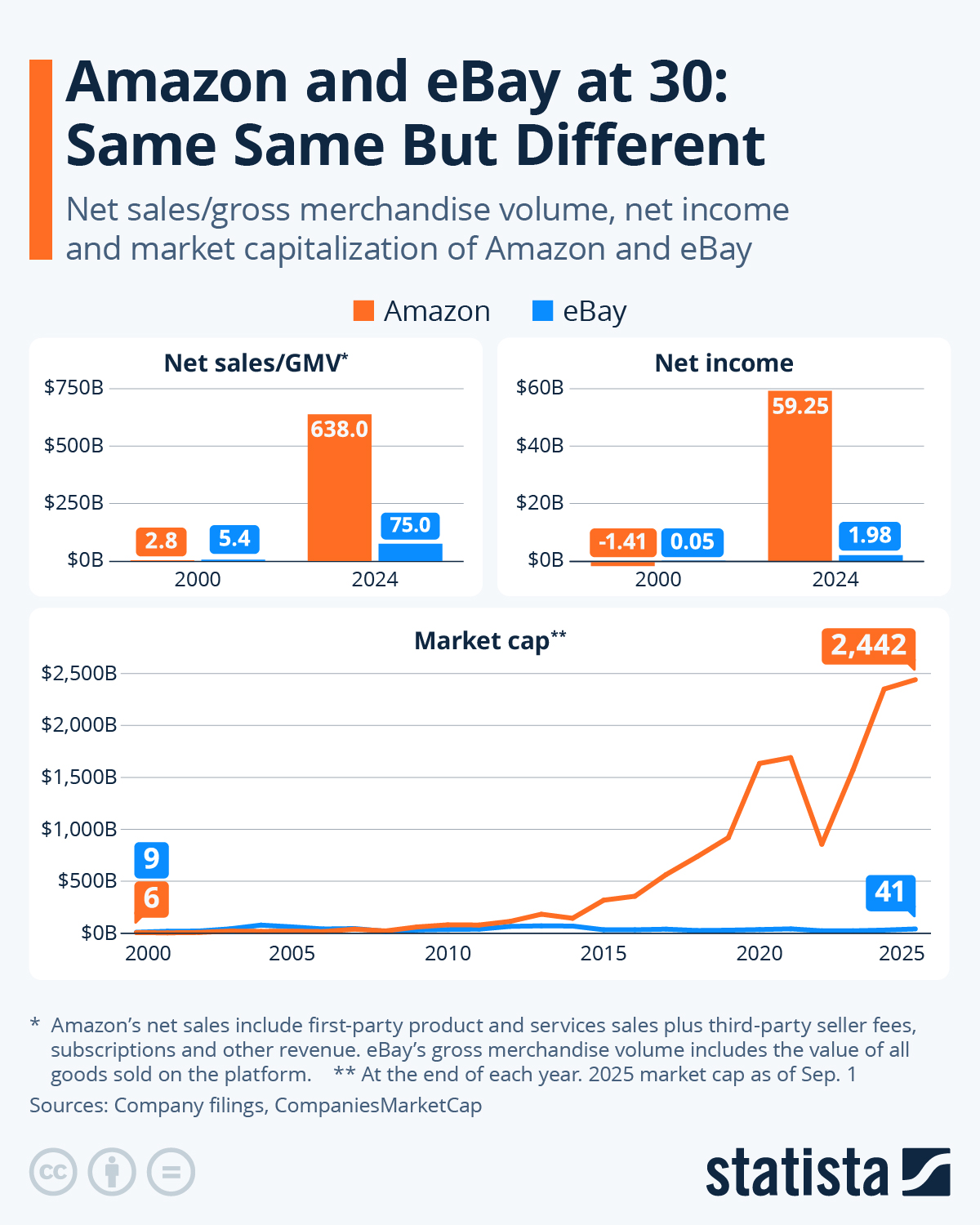
As our chart shows, eBay and Amazon were on equal footing in 2000, with eBay slightly ahead in terms of platform sales, profitability and market capitalization. And yet, 25 years later, the two companies are operating in different spheres. In 2024, Amazon’s net sales, which include first-party product and services sales plus third-party seller fees, subscriptions, cloud and advertising revenue, amounted to $638 billion, more than eight times eBay’s gross merchandise volume of $75 billion. In terms of profitability, Amazon is even further ahead with almost $60 billion in net income versus eBay’s $2 billion. These different dimensions are also reflected in both companies’ market cap: as of September 1, Amazon was valued at $2.4 trillion, almost 60 times eBay’s valuation of $41 billion.