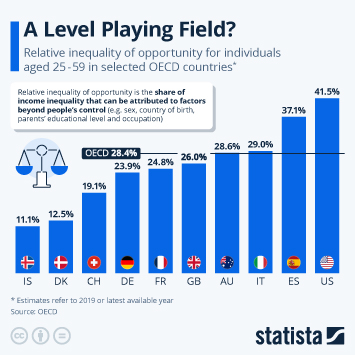
In order to effectively address inequalities of opportunity it is crucial to understand the factors that actually tilt the playing field to the disadvantage of affected groups. In its latest report on equal opportunities and the lack thereof, the OECD sought to identify these factors, measuring the relative importance of non-controllable circumstances on the relative inequality of opportunity.
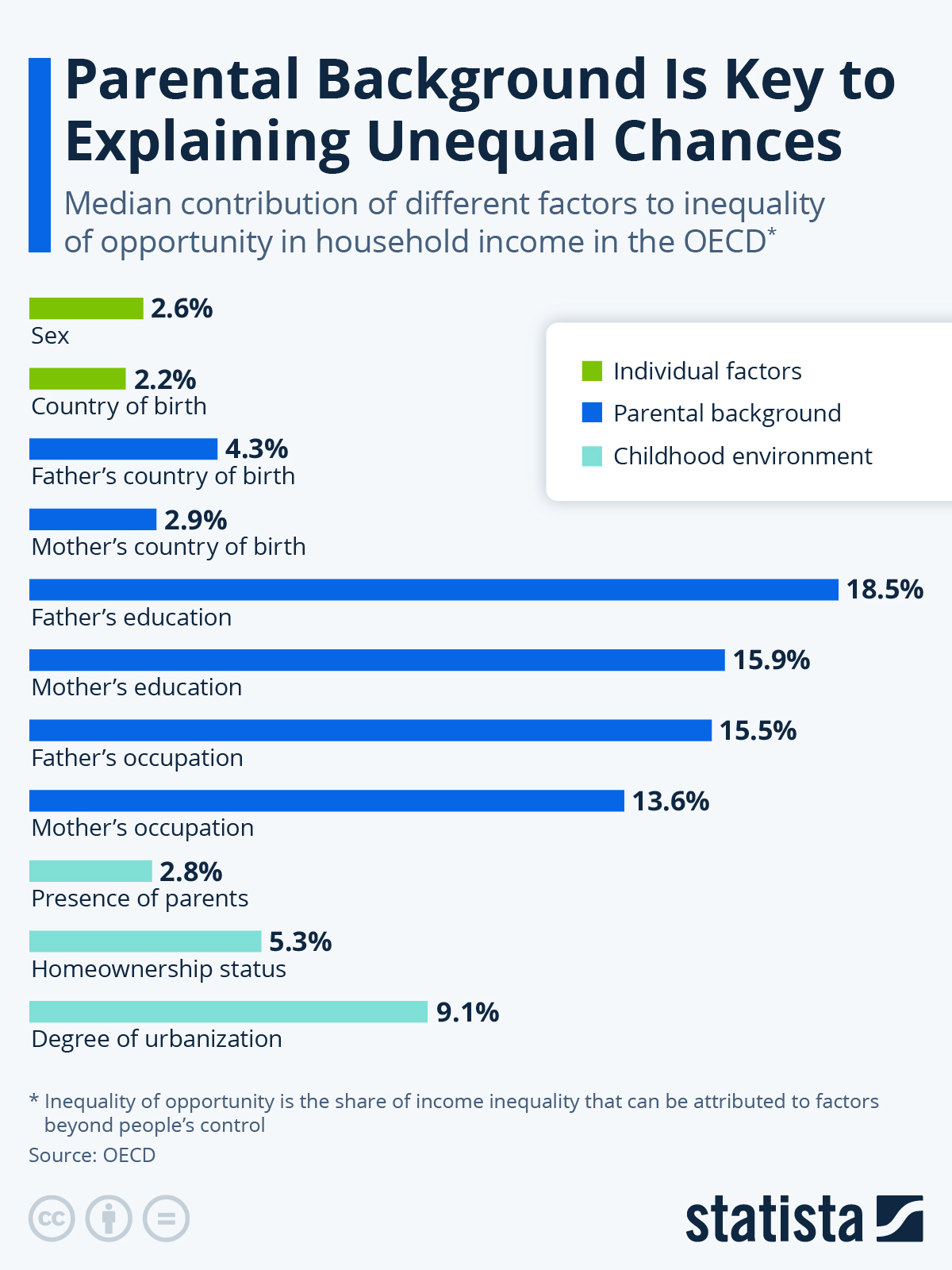
The study finds that the parental socio-economic background is by far the largest driver of unequal opportunities in many OECD countries. In half of the countries, over 60 percent of the observed inequality of opportunity can be attributed to the combined effect of parents' education and occupation, with the factors' relative importance even exceeding 75 percent in 1 out of 10 countries. Overall, paternal educational and occupational backgrounds tend to play a slightly larger role than maternal ones - an observation the authors at least partly attribute to lower labor market participation of women in previous generations.
The following chart sums up each of the 11 surveyed factors’ contribution to inequality of opportunity in household market income. The displayed figures represent the OCED median, meaning that half of the countries in the study had value this high or higher.