The fourth edition of the Reuters Institute for the Study of Journalism's Climate change and news audiences report shines a light on the way people engage with news and information on the climate crisis. The survey, conducted across eight countries, examines trends in climate news consumption, as well as the perception of the public on issues such as political leadership on climate change, and the environmenal impact of artificial intelligence.
The report highlights that the use of climate news and information is in decline in France, Germany, Japan, the UK, and the USA, while it remains stable in Brazil, India, and Pakistan. Interest in climate news and information, however, remains high and stable in most countries, suggesting that declines in climate news use are partly driven by reduced supply (especially on TV). Only France and Germany have seen their interest in climate news decline slightly since 2022.
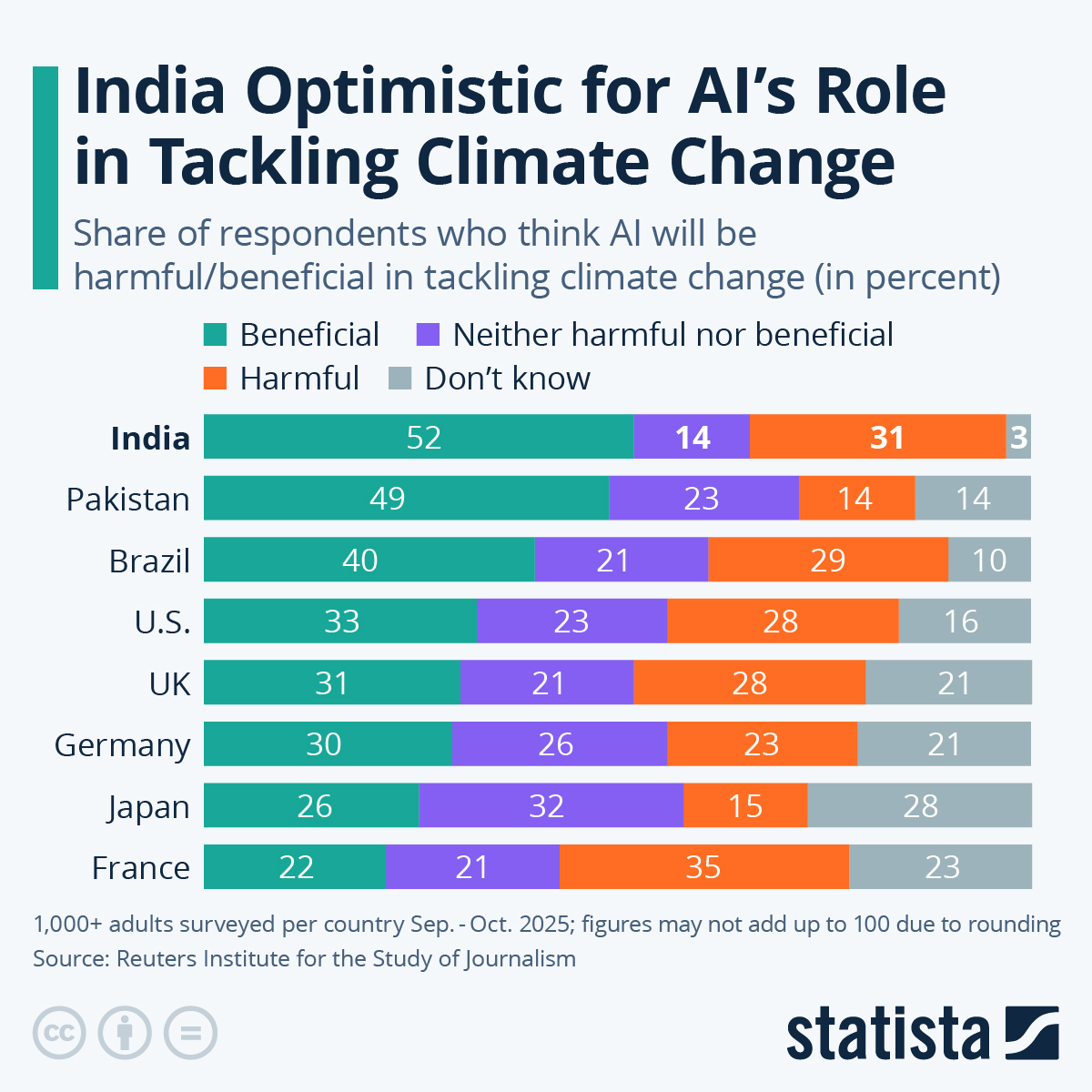
When it comes to the role of AI in tackling the climate crisis, the opinion is cautiously optimistic. Overall, 35 percent of those surveyed believe that AI will be beneficial in the fight against climate change, while 26 percent said AI will be harmful. Optimism for AI’s role in climate action is particularly strong in India and Pakistan, where 34 percent and 29 percent of respondents respectively see it as very beneficial. In contrast, France shows the greatest scepticism, with 35 percent viewing AI as harmful and only 23 percent as beneficial.
In the report, the RISJ points out that AI has the potential to optimise renewable energy systems and improve climate modelling and forecasting, but the technology's rapid growth also places new pressures on energy systems and increases electricity demand from data centres. "The news media could play an important role in helping the public make sense of competing narratives about AI and climate change. How they frame AI’s role in this context shapes whether it is seen as a driver of solutions or a source of new risks', they add.