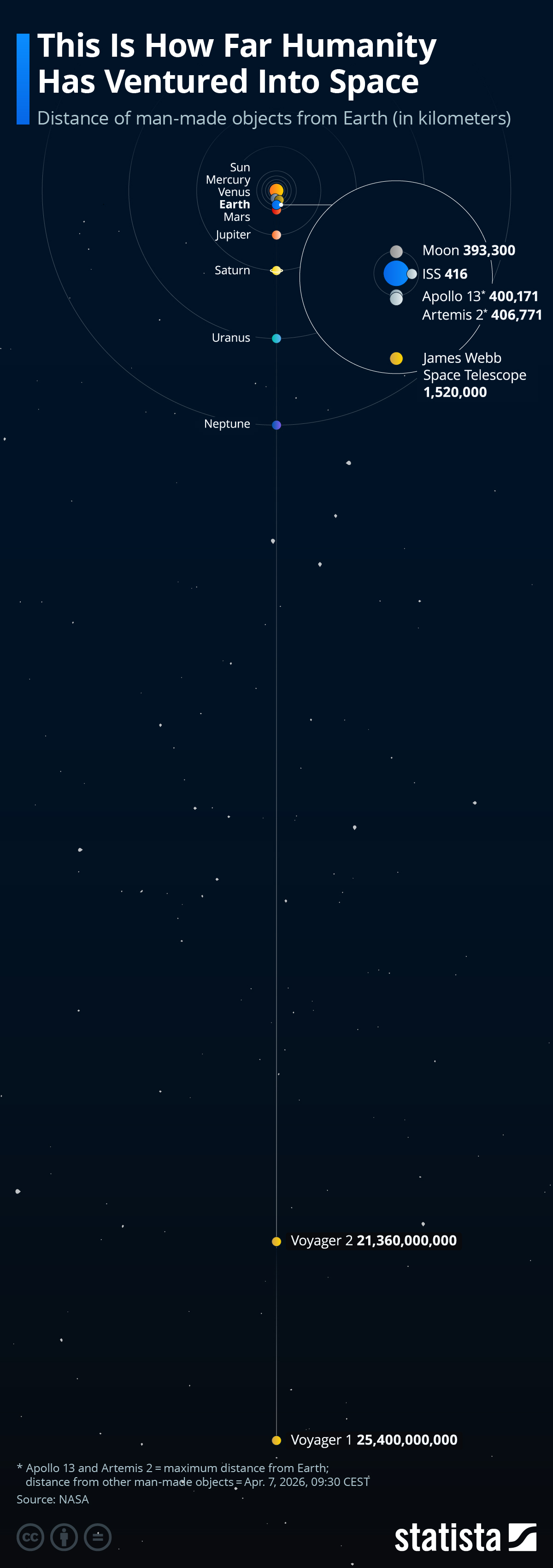
NASA’s Artemis II crew has set a new record for the farthest distance traveled by a crewed spacecraft. The crew of four, including Reid Wiseman, Victor Glover, Christina Koch and Jeremy Hansen, reached a peak distance of 406,771 km from Earth during their 10-day mission. This surpasses the previous record of 400,171 km set by the crew of the Apollo 13 in 1970.
The Apollo 13 mission was forced to abandon its planned lunar landing after an oxygen tank explosion on board. Instead, the crew looped around the moon and returned safely to Earth. Despite the aborted landing, the mission is widely considered a “successful failure” due to the astronauts' survival in what could easily have been a fatal voyage. The last time humans landed on the Moon was during Apollo 17 in 1972. Until Artemis II, no human mission had ventured beyond low orbit in the decades since.
While human spaceflight beyond low Earth orbit paused during this period, robotic missions continued to push much farther. According to NASA, the most distant human-made object is Voyager 1. Launched in 1977, it was approximately 25.4 billion km from Earth as of April 7 (09:30 CEST). Its twin, Voyager 2, was about 21.36 billion km away. Both spacecraft are now traveling through interstellar space beyond the solar system.
To put these distances into perspective, even relatively "nearby" objects in our solar system are far away. Mars, the Earth's neighboring planet, is some 401 million kilometers away, depending on its orbital position. By comparison, the Earth’s moon, which is not a planet as it orbits the Earth rather than the Sun, is about 394,300 km from the Earth.
The distances to the ISS, James Webb Space Telescope, and Voyager 1 and 2 were taken from a NASA tool and represent the distances as of April 7th at approximately 9:30 AM. Average values were used for the distances of the planets from Earth. The purpose of this representation is to provide a sense of scale. It is not a scientific representation of the solar system.