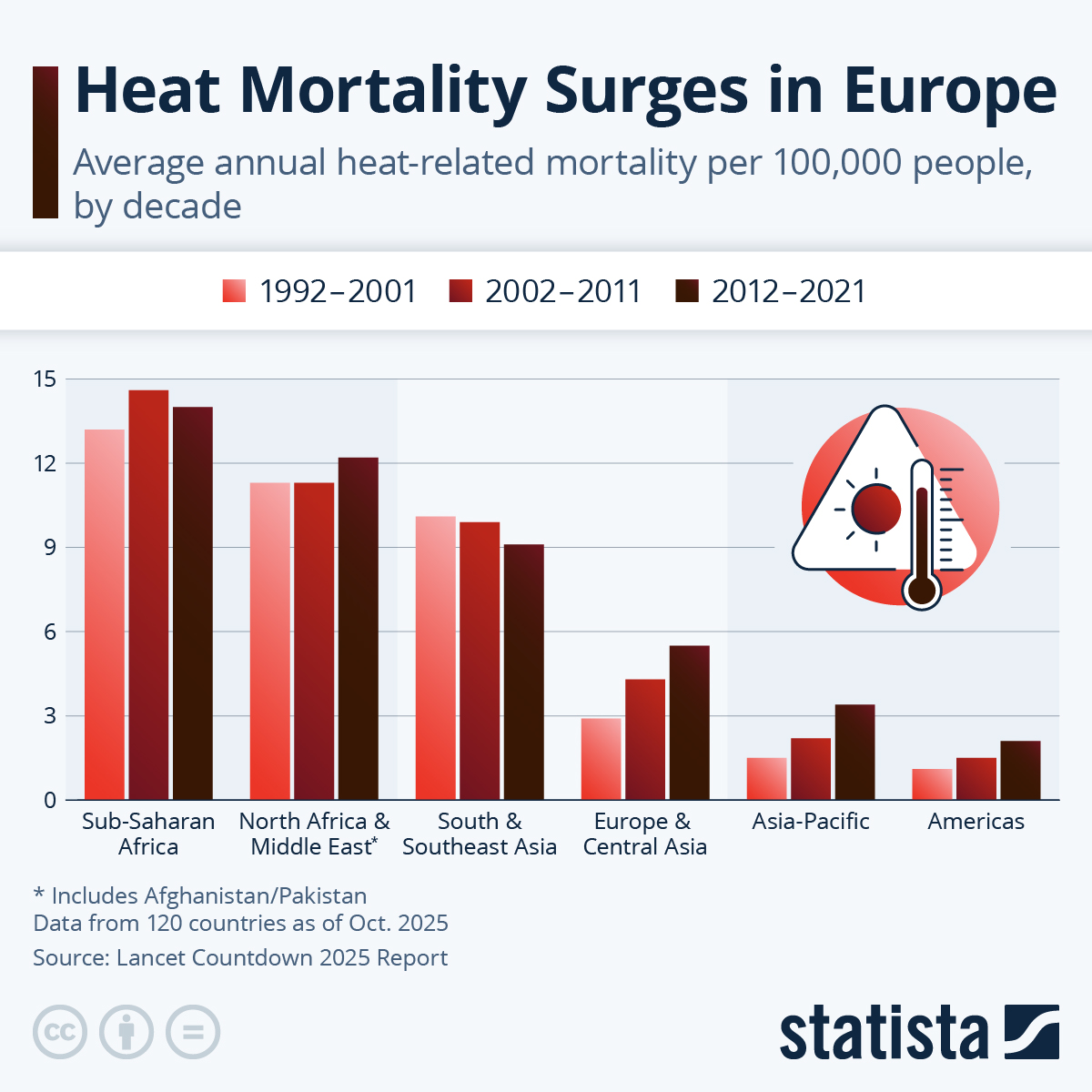
Heat-related mortality in Europe has surged over the last couple of decades. This is according to the latest available data published by the Lancet Countdown 2025 Report. Between 2012 and 2021, 5.5 people per 100,000 population died of heat-related causes per year on the continent. This is almost double the annual rate observed between 1992 and 2021.
Similarly rapid surges were observed over the same time period in Asia-Pacific as well as in the Americas. However, heat deaths stayed on a lower level in these regions and reached only an annual 3.4 and 2.1 in 100,000, respectively, during the last decade.
All three continents in question have an aging population, making heatwaves more deadly as it is older people who predominantly succumb to heat-related causes. But Europe is also less prepared than other continents for a changing climate as its many temperate regions have not built for the heat and have traditionally neither been equipped for it, may that be in terms of air conditioner ownership or knowledge of ways to stay cool.
Hotter (and younger) regions of the globe have not seen the same developments in heat-related mortality, even though they do experience consistently higher levels of it. In Sub-Saharan Africa, North Africa and the Middle East as well as South and Southeast Asia, brutal heatwaves claim the lives between nine and 14 people per 100,000 every year. In all three regions, this figure has changes by at most 10 percent since the 1990s.
While heat waves and spikes have always happened, climate change has made these longer, more severe and more frequent.