Having long been critical of international cooperation, President Donald Trump has doubled down on his America First stance during his second term. Since his return to the White House in January 2025, the U.S. has pulled out of numerous international organizations and the rhetoric employed towards long-standing allies has – on many occasions – been more confrontational than cooperative.
Last week’s NATO summit was the latest example of Trump’s confrontational style, when he harshly criticized Spain for its unwillingness to increase its defense spending to 5 percent of GDP under NATO’s new spending goal and its refusal to let the U.S. use Spanish air bases for operations against Iran. Trump’s behavior towards his allies is perhaps best described as inconsistent, as he tends to criticize them one day and praise them exuberantly on other occasions, especially in joint public appearances.
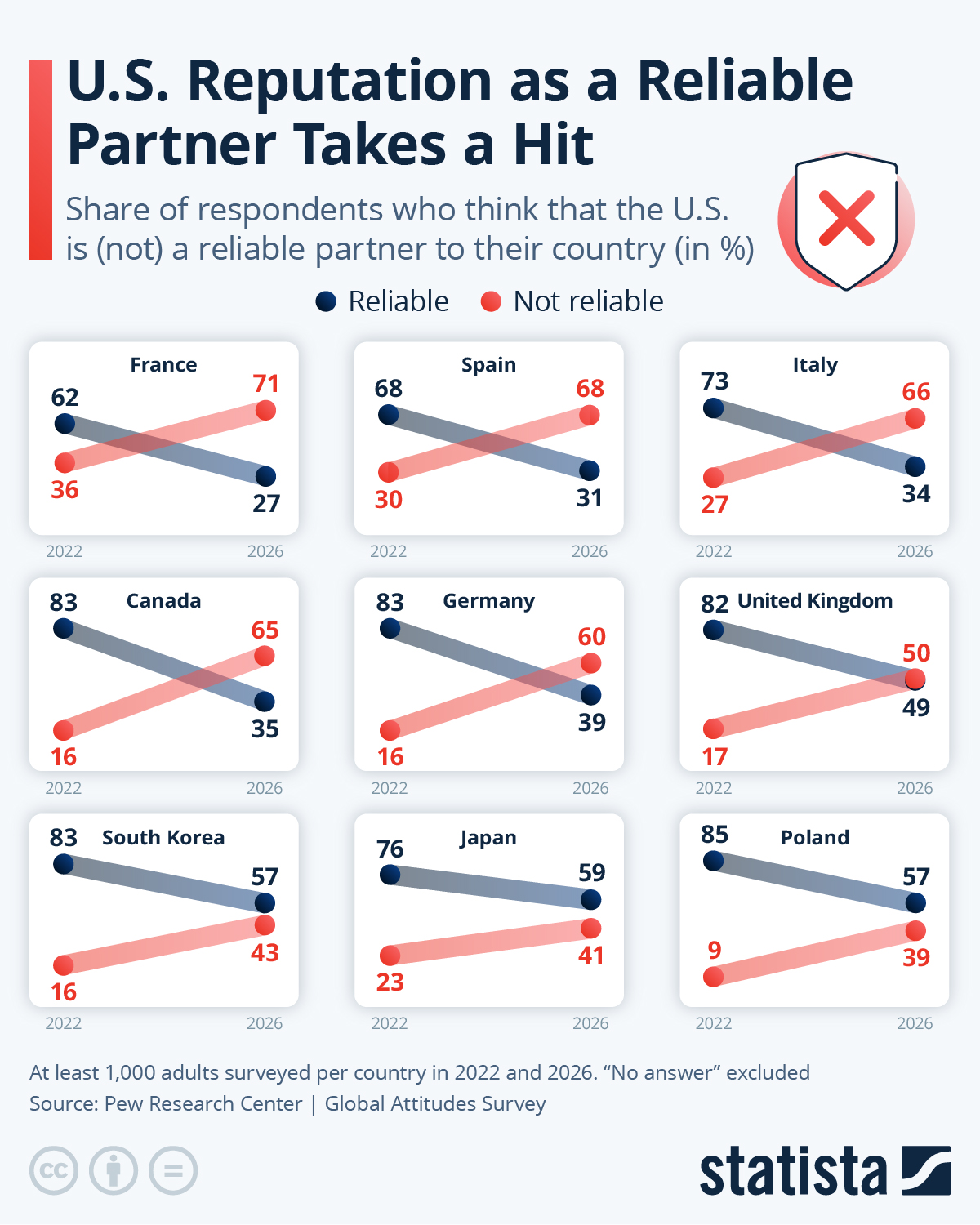
This unpredictability has made it difficult for U.S. allies to deal with the current administration, hurting the reputation of the United States as a reliable partner in global affairs. As our chart, based on data from the Pew Research Center's Global Attitudes Survey, shows, the international perception of the U.S. in that regard has reversed sharply since 2022, with majorities in several allied countries no longer viewing the U.S. as a reliable partner. Interestingly, the damage to the U.S. reputation has been most pronounced in Canada and Western Europe, whereas partners in Eastern Europe and Asia continue to express comparatively higher levels of confidence in the U.S.