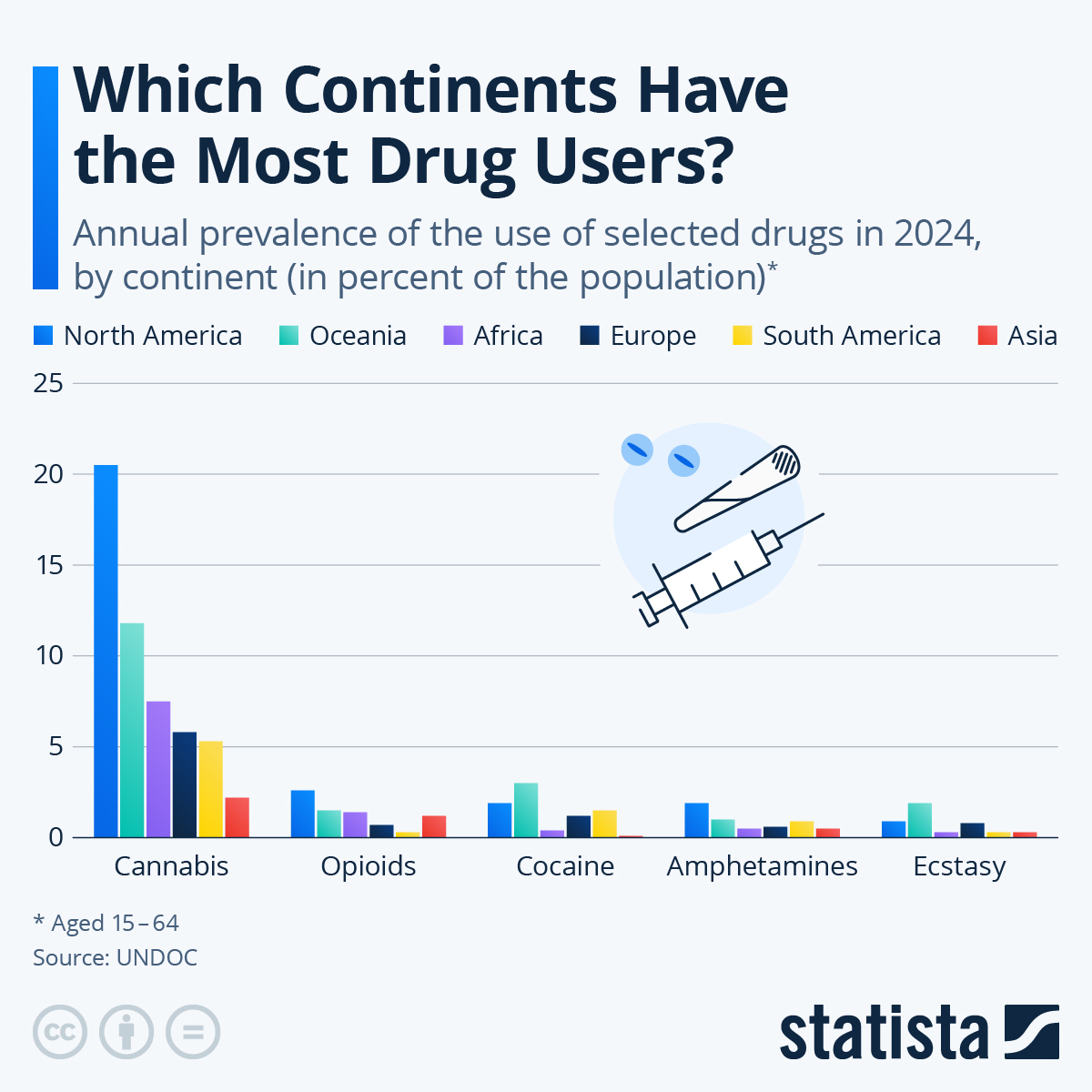
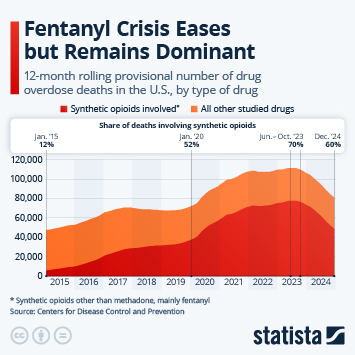
North America leads the world in the use of cannabis, opioids and amphetamines. According to numbers published today in the UN's World Drug Report, North Americans between the ages of 15 and 64 were 75 percent to 90 percent more likely to have consumed these drugs in 2024 than residents of second-ranked Oceania. The odds of dying of an accidental opioid overdose in the United States was still higher the same year as the risk of losing one's life due to a car crash or suicide. Despite this, overdose deaths in the U.S. have in the last couple of years come down from their peaks.
According to the report, broader marijuana legalization in the U.S. drove consumption. Oceania had the highest prevalence of cocaine and ecstasy use, mainly in Australia and New Zealand. South America saw a relatively high use of cocaine and amphetamines, while opioids were more widespread in Asia than in South America or Europe.
In total, 331 million people worldwide consumed drugs in 2024, equivalent to 6.2 percent of the global population. While marijuana remains the most common drug by far, the UN observed a change in the second-placed market for opioids. Here, synthetic opioids have been taking on an increasingly larger role in response to the crackdown on opium poppy production in Afghanistan. Strong synthetic opioids like fentanyl have been a major driver in the American overdose epidemic and as of 2025 were still detected in more than half of all U.S. drug deaths.
Amphetamines – at a global annual use prevalence of 0.6 percent the world's third biggest drug – have meanwhile seen their market globalize. Myanmar has emerged as a major producer country for amphetamines consumed globally and has also picked up opiate production as Afghanistan's output decreased. The UN also said it was seeing drug manufacturers using innovation as a tool to "skirt regulations and avoid detection", leading to the type of drugs found in seizures continuously evolving and increasing in variety.